
Part 1:
Three years after my divorce was finalized, I casually asked my right-hand man to find out how my ex-wife was doing. I expected him to return with a simple street address or perhaps the name of her current employer. Instead, exactly one hour later, Raymond burst into my office, slammed a color photograph onto my mahogany desk, and whispered, “Boss… Savannah has twins.”
For a moment, I forgot how to breathe. My mind struggled to process what I had just heard.
My name is Gabriel Mercer. I am thirty-nine years old, and I control one of the most powerful private enterprises in Minneapolis. Raymond Miller has worked beside me for twelve full years. He has witnessed street shootings, corporate betrayals, and federal investigations without ever blinking an eye.
Yet right now, he looked visibly shaken.
“How old are they?” I asked, my voice barely working.
“Two and a half years old. A boy and a girl,” he replied, gently pushing the glossy photograph closer to my trembling fingers. “Gabriel, you really need to look at them.”
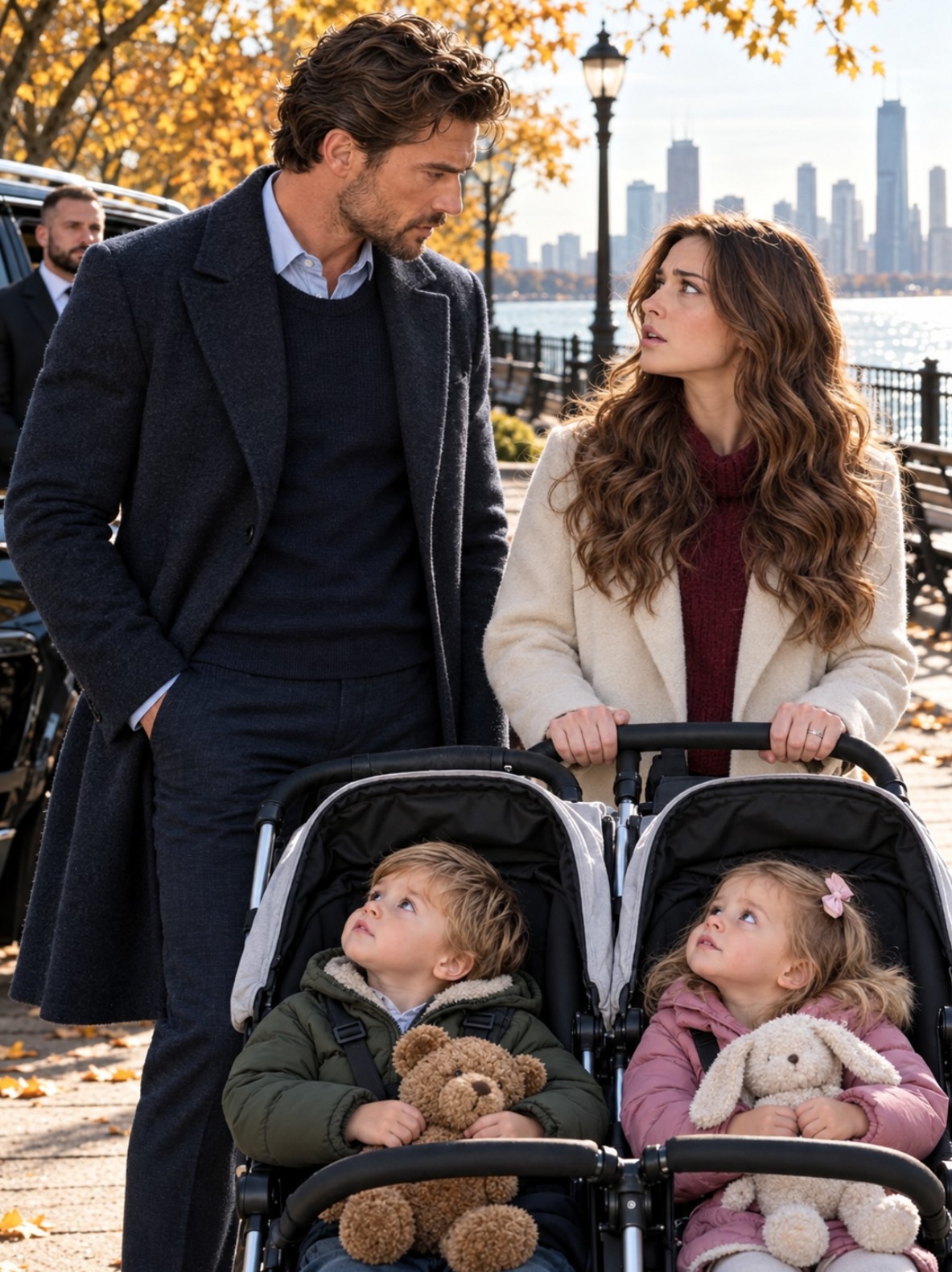
In the photograph, Savannah was walking along a scenic riverfront path in Saint Paul, pushing a double stroller along the paved trail. She looked noticeably thinner and somewhat older, not because of the years themselves, but because of the weight of everything she had endured since leaving me.
Then my eyes settled on the little girl’s face.
She had my dark eyes.
She had my exact nose.
Even the slight angle of her eyebrows reminded me of my own childhood photographs.
“When exactly were they born?” I asked, feeling my hands begin to shake.
Raymond hesitated before answering.
“Exactly six months after your divorce was finalized.”
The entire room seemed to tilt beneath my polished leather shoes.
Six months.
Savannah had been carrying my children when she signed the divorce papers and walked out of my life.
Suddenly, memories I had buried beneath years of work came rushing back.
I remembered Savannah throwing up every morning before breakfast. I remembered her falling asleep on the sofa at seven in the evening. I remembered her standing in the bathroom doorway with something small in her hand while I remained completely absorbed in an urgent phone call.
“Gabriel, can we please talk right now?” she had begged me.
“We’ll talk later,” I had replied without even turning around.
“This is really important,” she had insisted softly.
“Everything is important when I’m handling business,” I had snapped.
Then I remembered the doctor’s appointment she had desperately wanted me to attend with her.
Instead of accompanying my wife, I had simply sent a private driver to take her to the clinic.
She had looked at me with tears in her eyes and said, “I don’t need a driver. I need my husband.”
I had gone straight to a high-stakes board meeting anyway.
I had ignored her completely.
“Why didn’t she tell me?” I whispered into the silent office.
Raymond offered no answer.
His uncomfortable silence gave me the painful truth I deserved to hear.
Perhaps she had tried to tell me again and again.
“Find out every single detail about her life right now,” I ordered firmly. “And absolutely nobody tells my mother about this.”
I was especially determined to keep my mother, Eleanor Mercer, in the dark.
If Eleanor discovered that she had biological grandchildren living in Saint Paul, she would arrive with aggressive attorneys, armed security guards, mountains of cash, and threats of a custody battle before the sun went down.
I knew my mother well enough to understand that she would consider the children another part of the Mercer family legacy to protect and control.
After Raymond left the office, I sat alone and stared at the photograph.
For two and a half years, those sweet children had been learning to walk, learning to talk, celebrating birthdays, and crying after bad dreams.
And I hadn’t known they existed.
Then Savannah’s final warning echoed through my mind. It was something she had said on the day she packed her bags.
“One day, Gabriel, you’re going to realize what you threw away.”
I was already holding my cell phone tightly in my palm.
I had kept her number saved in my contacts throughout our separation.
For three long years, I had never found the courage to call her.
Now, with trembling fingers, I pressed her name and lifted the phone to my ear.
It rang once.
Twice.
Three times.
“Hello?” a deep male voice answered.
I froze.
“I’m looking for Savannah Miller,” I managed to say.
“Who’s asking?” the man replied calmly.
“This is Gabriel Mercer, her ex-husband.”
There was a brief silence.
Then the man laughed softly.
“Ex-husband?” he asked.
My entire body tightened with anger and confusion.
“Yes. That’s correct.”
“You’ve got the wrong idea entirely, Mercer.”
“What does that mean?” I demanded.
“It means this is my wife’s phone you’re calling.”
My blood turned to ice.
Before I could respond, the line went dead.
I immediately called again.
It went straight to voicemail.
I tried a third time.
The same thing happened.
Another man might have spent the last two and a half years raising the children who were biologically mine. Maybe my little girl ran happily into his arms when he came home. Maybe my son looked up at him and called him Dad every morning.
The thought was almost unbearable.
Suddenly, my phone buzzed with an incoming call.
It was Raymond.
“Boss, there’s something else you need to know,” he reported quickly.
“What is it?” I asked.
“I’ve just identified the man who answered Savannah’s phone.”
“Who is he?”
Raymond hesitated.
In twelve years, I had almost never heard him hesitate.
“That’s the real problem,” he said gravely. “Savannah’s life in Saint Paul is nothing like we assumed.”
I slowly rose from my leather chair.
“What aren’t you telling me?”
“I think you need to see this situation with your own eyes.”
I grabbed my heavy winter coat and snatched the photograph from the desk.
“Get the car ready. Immediately.”
“Where are we going?” Raymond asked.
I looked once more at the photograph of Savannah and the two children whose innocent faces had just shattered my entire world.
“Saint Paul.”
Because for once in my life, I wasn’t traveling as Gabriel Mercer, the powerful man Minneapolis feared.
I was traveling as the foolish husband who had failed his wife.
And I was traveling as a father whose own children didn’t even know his name.
Part 2:
Saint Paul greeted us beneath a dark gray sky in early November.
Rain streaked the side windows of the black sedan as we crossed into the city. The streetlights along the Mississippi River blurred into ribbons of soft gold. I watched pedestrians hurry beneath umbrellas, young couples share heavy coats, and college students clutch warm coffee cups against the cold.
Somewhere among these busy streets was Savannah.
Somewhere nearby, my children were growing up without knowing I existed.
Raymond sat across from me in the quiet cabin, holding his phone in one hand and the photograph in the other. He had barely spoken since we left Minneapolis.
His silence worried me more than any warning could have.
“What exactly did you find out about her situation?” I asked.
He looked across at me through the dim light.
“Her home address is in a historic district on Grand Avenue. She lives in a small brick townhome, and she works three days a week at a neighborhood children’s shelter near the river.”
“And what about that man?”
“His name is Lucas Bennett. He’s thirty-eight and works as a pediatrician at the local children’s hospital.”
I stared through the rain-streaked window.
“Her husband,” I murmured.
“That is what the public records indicate,” Raymond confirmed.
His words landed heavily on my chest.
I had no legal or moral right to be surprised. Three years had passed since our bitter separation. I had walked away from Savannah with my pride intact and my corporate priorities unchanged.
If she had rebuilt her shattered life with someone else, I had nobody to blame but myself.
Still, the thought of another man standing in her warm kitchen, drinking from her favorite coffee mug, and comforting the children when they cried at night made me clench my fists.
I closed my eyes.
“Do the children have his last name?” I asked quietly.
“Their names are registered as Maya Bennett and Caleb Bennett.”
They carried the name Bennett.
Not Mercer.
Their legal records listed Lucas as their father, not me.
I looked down at the photograph in my lap.
Little Maya wore a bright yellow coat and a knitted hat decorated with two fluffy pom-poms. Caleb sat beside her in the double stroller, holding a tiny red toy truck. Savannah’s gentle hand rested on the stroller handle.
She looked remarkably peaceful.
That was what hurt me most.
Peace was something I had never managed to give her during our marriage.
Raymond shifted uncomfortably in his seat.
“Boss, there’s more to the story.”
“There always is,” I replied wearily.
“I checked the available public records and spoke with someone at the community resource center. Savannah hasn’t hidden herself away from the neighborhood. People know her well, and they respect her.”
I almost smiled sadly.
“She always had a passion for helping vulnerable people.”
“I know,” Raymond said softly.
“Does Lucas work at the same center?”
“Not full-time. However, he volunteers there on weekends, providing free pediatric screenings and arranging medical referrals for low-income families.”
I turned back toward the rain-covered window.
The picture formed far too easily in my mind.
I imagined Savannah laughing with Lucas while he carried the tired children into their warm home. I pictured him kneeling on the carpet to zip up Maya’s winter coat. I imagined him answering Savannah’s phone without hesitation and proudly calling her his wife.
It was a complete life that had flourished without me.
Perhaps that was precisely what I deserved.
The sedan stopped outside the Grand Avenue address shortly after four in the afternoon.
The heavy rain had eased into a light mist. The neat brick townhome stood between two older buildings decorated with colorful window boxes and bicycles locked to their front porches.
Warm light glowed behind the linen curtains on the second floor.
I remained frozen in my seat.
Raymond opened his door and looked back at me.
“Are you coming to the door?”
“I honestly don’t know.”
He studied my face.
“You drove across the entire metropolitan area to get here.”
“That doesn’t mean I know what to say to her.”
“You don’t have to explain everything in one evening.”
“What am I supposed to say when she opens the door?”
“The truth,” Raymond advised.
I gave him an exhausted look.
“You make it sound so simple.”
“It isn’t simple,” he admitted. “But lying to her now will only make the damage permanent.”
I stepped out of the car and braced myself against the biting cold.
The wrought-iron gate creaked beneath my hand as I pushed it open. I walked up the damp stone steps slowly, each step making my chest feel tighter.
At the front door, I stopped before a small brass nameplate.
Four names were engraved on it.
Savannah Bennett.
Lucas Bennett.
Maya Bennett.
Caleb Bennett.
Four names.
Not one belonged to Gabriel Mercer.
I raised my hand and knocked firmly.
For several seconds, silence answered.
Then I heard footsteps approaching.
The door opened, and I found myself looking directly at Lucas Bennett.
He was taller than I had expected, with dark blond hair and remarkably calm features. He wore a navy sweater over a crisp white shirt, the sleeves rolled neatly to his elbows. A faint streak of baking flour marked his left cheek.
His intelligent eyes moved from my face to Raymond and then returned to me.
Recognition settled across his features.
“You’re Gabriel,” he said.
It wasn’t a question.
I gave a stiff nod.
“I am.”
Lucas stepped outside and closed the front door behind him.
The movement was polite, yet unmistakably protective.
“Does Savannah know you’re standing out here?” he asked.
“No. She has no idea.”
“Then you shouldn’t have come here tonight.”
“I know I shouldn’t have.”
My honest admission seemed to surprise him.
He folded his arms across his chest to block the wind.
“What do you want?”
“I need to speak with her.”
“She doesn’t want any contact with you.”
His quiet words struck me harder than I expected.
“Did she tell you that directly?”
“She made it very clear that she wanted to be left alone.”
“You mean three years ago, when she left?”
“She has repeated that wish consistently ever since.”
I looked past his shoulder toward the warm light beneath the door.
“Are the children inside?”
“Yes.”
“Can I please see them?”
“No.”
I swallowed against the painful lump in my throat.
“I’m their biological father.”
“You don’t know that for a fact.”
“I have very strong reasons to believe they’re mine.”
“You have a photograph. Nothing more.”
His tone remained calm, but there was no mistaking his determination.
“Two and a half years ago, Savannah arrived here in Saint Paul carrying two tiny infants and a single suitcase,” Lucas explained. “She had no money, no family living in this state, and absolutely no desire to be tracked down by your organization. I met her at the community center and helped her find housing, employment, and proper healthcare. Over time, our professional relationship grew into a deep friendship.”
He paused, allowing his words to settle.
“She never told me who the children’s biological father was.”
I stared at him in surprise.
“You knew they weren’t biologically yours?”
“No, they’re not,” he replied. “But I became their real parent in every way that matters.”
“And then you married her.”
“Yes.”
“Why?”
Lucas lowered his eyes briefly before meeting mine again.
“Because we grew to love each other. Because we built an honest, stable life together. Because those two innocent children deserved safety. And because Savannah had spent years believing that if she trusted the wrong man, everything she loved could be taken away from her in an instant.”
His gaze remained steady.
“She was deeply afraid of you, Gabriel.”
I had heard those words before, but never from a stranger standing between me and my former wife.
“Was she afraid of me personally?”
“She was afraid of your entire world. Your family, your ruthlessness, and the power attached to your last name.”
“I would never hurt her.”
“I believe you mean that right now,” Lucas replied quietly.
Suddenly, the front door opened behind him.
“Lucas?” Savannah called softly.
Every muscle in my body locked.
Lucas turned toward her.
She appeared in the warm doorway wearing a soft gray cardigan, her brown hair tied loosely at the back of her neck. She looked older than the woman I remembered, but she had not diminished in the slightest. There was a steady confidence in her eyes that I had rarely seen during our marriage.
Then she looked at me.
All the color drained from her face.
“Gabriel,” she whispered.
My name sounded like a long-buried memory she had carefully locked away.
I wanted to apologize for everything. I wanted to explain why I had come. I wanted to ask whether little Maya had my eyes because she was truly my daughter.
Instead, all I managed to say was, “Hello, Savannah.”
Her right hand tightened around the doorframe.
Lucas glanced back at her.
“Do you want me to call the police or security?”
“No,” Savannah answered quietly, her voice gradually steadying.
She looked directly at me.
“Why are you here?”
“I found out about the children today.”
Her expression changed. It wasn’t shock. It was exhaustion, deep and overwhelming.
“I honestly wondered when this day would finally arrive.”
That sentence made my heart stumble.
“You knew I might eventually find you?”
“I knew Raymond Miller was exceptionally good at his job.”
I glanced toward the street, where Raymond stood beneath a black umbrella.
“How long have you known he was looking for you?”
“I found out yesterday morning.”
“Then why didn’t you call me?”
A faint, bitter smile touched her lips.
“You never called me once in three years.”
There was no petty anger in her voice. That absence of hatred hurt ten times worse.
“I didn’t know about Maya and Caleb.”
“You should have known.”
“I know,” I admitted.
She looked toward the dark street.
Inside the house, a toddler laughed. Another tiny voice called out, “Mommy!”
Savannah closed her eyes briefly, as if the sound anchored her to the life she had built.
“Would you like to come inside for a few minutes?” she asked.
Lucas turned toward her with concern.
“Savannah, are you sure?”
“I’m not inviting him to stay,” she reassured him. “I just want to hear what he has to say.”
Lucas studied her face, then stepped aside.
I entered the house.
The first thing I noticed was how warm and ordinary everything felt.
Tiny winter boots stood beside a radiator. A ceramic bowl held colorful hair clips. Children’s finger paintings covered part of the wall. A wooden toy train sat beneath the staircase.
Then I saw a framed photograph of Savannah in a hospital bed, cradling two newborn infants.
She was crying openly.
They weren’t tears of pain, I realized with a sharp ache.
They were tears of joy.
I couldn’t take my eyes off the picture.
“They were born at the local hospital here in Saint Paul,” Savannah explained quietly. “A healthy boy and a girl. Caleb arrived first. Maya was born exactly seven minutes later.”
My throat tightened.
“Are they my children?”
Her gentle expression instantly became guarded.
“Is that really the main question you drove all the way here to ask?”
“It’s the most important question I’ve ever asked.”
“No, Gabriel,” she corrected sadly. “The most important question should have been asked two years and six months ago.”
“I didn’t know you were pregnant.”
“You didn’t want to know.”
The truth of her words left me defenseless.
Lucas moved toward the living room.
“I’ll take the children upstairs to play.”
“No,” Savannah said firmly. “They don’t need to be hidden away or involved in this.”
“They aren’t involved,” Lucas replied gently. “They’re simply watching a stranger stand in their hallway.”
That single word burned into my soul.
Stranger.
Lucas went upstairs. Moments later, I heard little feet pattering across the floor and his calm voice explaining that Mommy had a visitor downstairs.
Savannah walked into the kitchen, and I followed slowly.
The room smelled of cinnamon and freshly baked bread. A small pot simmered on the stove. Two plastic toddler cups, one pink and one light blue, sat on the wooden counter. A wall calendar was covered with pediatric appointments, daycare events, and colorful drawings.
This was her real life.
It wasn’t a temporary hiding place.
It wasn’t a miserable chapter waiting for me to arrive and rescue her.
It was a home.
Savannah leaned against the counter and looked at me.
“Who finally told you?”
“Raymond.”
“Of course.”
“He managed to get a photograph.”
“Our neighbor took it,” she explained. “She shared it with someone in Minneapolis who recognized my maiden name.”
“Why didn’t you tell me when you found out you were pregnant?”
Savannah lowered her eyes.
“I tried to tell you.”
My breath caught.
“What do you mean?”
“I tried to reach you several times. Before the divorce was finalized. After the twins were born. And once more through your corporate office.”
“I swear I never received a single message or letter.”
“I know you didn’t.”
Her certainty confused me.
“How can you possibly know that?”
“Because I kept duplicate copies of every letter I sent.”
She walked to a built-in desk, opened a wooden drawer, and removed a thin brown folder. Its edges were worn, and the papers inside were arranged in chronological order.
She placed it on the kitchen table.
The first page was a copy of a handwritten letter addressed directly to me.
*Gabriel,*
*I don’t know if you’ll ever read these words. I don’t know if you even care anymore. But our children were born healthy last week. They are a boy and a girl. I’ve named them Caleb and Maya.*
My hands began to shake.
I turned to the next page.
*Gabriel,*
*I’m not writing this to beg you to return to our marriage. I’m writing to ask whether you want to be a father to your children. If you want to know them, please write back to me at the safe address listed below.*
The date at the top was six weeks after the twins’ birth.
Several more letters followed.
One had been written three months later. Another was dated just after their first birthday. The final letter had been written nine months earlier.
*You once claimed that I made every simple thing difficult. Perhaps this is the only way I know how to make a clean choice. If you want a genuine place in their lives, you must approach us honestly, not as a powerful Mercer, and not surrounded by armed guards, corporate lawyers, or piles of money. You must come simply as yourself.*
I lifted my eyes.
“Why didn’t I receive these?”
“I mailed every single one directly to you.”
“To which address?”
“Your main corporate office in Minneapolis.”
I shook my head in disbelief.
“My personal office logs and opens every piece of mail.”
“Apparently, they didn’t log these.”
I examined the copies carefully. The envelopes had clearly been opened and resealed. There were no official postal stamps on the copies, only handwritten dates along the margins.
“Who handled your incoming personal mail back then?” Savannah asked.
“My chief administrative assistant.”
“What was her name?”
“Clara Miller.”
Raymond had mentioned her months earlier. Clara had served as my mother’s trusted private secretary for nearly twenty years before taking an unexpected early retirement shortly after my divorce was finalized.
A cold dread spread through my chest.
“Did you send anything else besides these letters?”
Savannah hesitated.
“I sent an official medical report.”
“What kind?”
“The twins’ original birth certificates and hospital records. I assumed you’d demand undeniable proof before believing me.”
I stared at her in shock.
“You never mentioned their names to me before today.”
“I was terrified you’d use your influence to take them away from me.”
“I would never do that.”
“You say that now.”
She reached into the folder and pulled out a smaller, yellowed envelope.
“This document was returned to my mailbox unopened.”
I took it from her.
The paper was heavily creased, its edges yellowed with age. My full name was written neatly across the front in Savannah’s unmistakable handwriting.
**Gabriel Mercer**
**Mercer Enterprises**
**Minneapolis, Minnesota**
Across the lower-right corner, someone had stamped the words in bold red ink:
**ADDRESSEE UNAVAILABLE.**
Yet I had been available every single day.
I had spent twelve hours in my office day after day.
I turned the envelope over. Its seal had clearly been broken and then smoothed flat again.
Inside was a sheet of hospital stationery and a photograph taken in the maternity ward.
Savannah lay in a hospital bed beside two small plastic bassinets.
Caleb was sleeping peacefully beneath a light blue blanket.
Maya was wide awake, her tiny hand reaching toward the camera.
I could barely breathe as I looked at my daughter.
“I swear I didn’t know about this,” I whispered.
“I actually believe you,” Savannah replied gently.
Her lack of anger hurt far more than screaming would have.
“You believe me?”
“I believe you never physically received the letters. I don’t know why they were kept from you.”
Neither did I.
But I was determined to find out.
A floorboard creaked on the second floor.
Savannah gathered the scattered papers and slipped them back into the folder.
“I think you need to leave now, Gabriel.”
“I understand.”
“Do you really?”
She pressed the folder against her chest.
“You built a massive life in Minneapolis. You cannot simply merge it with ours because you discovered we exist today. Maya and Caleb are not legal evidence to collect. They’re not business assets. They’re real, living children.”
“I know.”
“Do you really?” For the first time, her voice trembled. “I’ve spent two and a half years protecting them from chaos and threats. I won’t let you sweep into their lives with grand promises, only to disappear the moment work demands your attention again.”
“I won’t disappear.”
“You disappeared long before they were born.”
“I walked away from our marriage,” I said softly. “I didn’t knowingly walk away from my children. I had no idea they were here.”
“But you knew I was struggling before I left.”
Her words silenced me.
I looked down.
“I suspected something was wrong. You tried to talk to me, but I was too consumed by my own ambition to listen.”
“And after I packed my bags?”
“I assumed you wanted a clean divorce.”
“I did want a divorce.”
Her honesty was brutal.
“But it wasn’t because I’d stopped loving you,” she continued. “I demanded a divorce because I finally understood that I was married to a man who had no space left in his life for me. I begged you to attend one medical appointment. Just one. And you sent a hired driver instead.”
“I was completely wrong.”
“Yes, you were.”
The words hung between us.
Upstairs, Caleb laughed happily. A moment later, Maya’s sweet voice joined his.
Savannah looked toward the ceiling.
“They know Lucas as their real father.”
I nodded, even though the movement felt like a knife in my chest.
“He’s been there for every high fever, every nightmare, and every important moment. He taught Caleb how to build block towers. He held Maya when she was terrified of thunder.”
“I’m not asking him to step aside.”
“You don’t have the right to ask for anything yet.”
“I know.”
She studied my face.
“You keep saying that.”
“Because I’m finally beginning to understand it.”
Suddenly, a car door slammed outside.
Raymond appeared in the kitchen doorway.
“Boss,” he began.
Savannah’s face tightened at the title.
Raymond noticed and immediately corrected himself.
“Gabriel. Sorry for interrupting.”
“What is it, Raymond?”
He held up his phone.
“I just finished speaking with Clara Miller.”
My pulse jumped.
“What did she say?”
“She still lives in the Minneapolis suburbs. She refused to discuss your personal mail over an unsecured phone call. However, I sent an associate to check your old corporate archive room.”
“What did he find?”
“A locked filing cabinet in the back storage room. It was listed under your mother’s personal family records.”
Savannah froze.
Raymond continued, “The cabinet was never cleared when Clara retired. The facility manager gave my associate access.”
“What was inside?”
“Letters.”
I looked at the brown folder in Savannah’s hands.
“How many?”
“Seven personal letters from Savannah, two official medical documents from the hospital, and one formal letter from a family-law attorney.”
Savannah’s lips parted in shock.
“An attorney?”
Raymond turned toward her.
“There was also a sealed envelope addressed directly to Gabriel. It had never been opened.”
“Whose handwriting was on it?” I asked.
Raymond turned his phone toward me.
The photograph showed a cream-colored envelope covered in dust. My full name was written across the front in elegant handwriting.
Beneath it, in smaller cursive letters, was a sentence that made my blood run cold.
**Eleanor Mercer. Do Not Forward Under Any Circumstances.**
Savannah gripped the back of a wooden dining chair.
“Your mother,” she whispered.
Raymond nodded grimly.
“And Gabriel,” Savannah added, staring at the photograph, “that particular envelope was sent long before the twins were even born.”
I looked at her pale face.
“What was inside it?”
She slowly shook her head.
“I honestly don’t know.”
Raymond’s phone suddenly buzzed with a new message.
He read it, and his professional composure visibly broke.
“What happened now?” I demanded.
He looked from me to Savannah.
“That envelope was officially opened twenty minutes ago.”
“Opened by whom?”
Raymond lowered his voice.
“Your mother.”
Part 3:
Those two words settled over the warm kitchen like a sudden drop in temperature.
“Your mother,” Savannah repeated softly, resting one hand on the wooden counter.
Raymond lowered his phone.
“I don’t know why she chose to open it tonight. I only know that the facility manager personally witnessed her entering the archive room about twenty minutes ago. Clara Miller was with her.”
“Where are they now?” I demanded.
“Clara left the building immediately afterward. Your mother is still inside, alone.”
I turned toward Savannah.
Her face was pale, but there was no terror in her eyes. She simply looked exhausted, as though a suspicion she had carried for years had finally been confirmed.
“Did your mother take the envelope with her?” Savannah asked.
Raymond nodded.
“She walked out holding it.”
Lucas appeared in the kitchen doorway. He had changed into a comfortable green sweater, and his expression darkened when he noticed the tension.
“What happened?” he asked gently.
Savannah didn’t answer immediately.
“My mother intercepted and opened all of Savannah’s personal letters,” I explained.
Lucas looked from the folder on the table to Savannah’s pale face.
“Eleanor did this?”
“Yes,” Savannah confirmed quietly.
Lucas tightened his jaw.
“Well, that explains a great deal.”
I stepped toward him.
“What exactly does it explain?”
“Nothing I can legally prove in court,” Lucas replied.
“Tell me anyway.”
He glanced at Savannah, seeking her permission. She gave him a small, tired nod.
“When Savannah first arrived in Saint Paul, she carried a formal letter from your mother,” Lucas explained. “Savannah told me Eleanor had contacted her shortly before she left Minneapolis. According to Savannah, Eleanor said you’d made your final decision and that bringing innocent children into the situation would only cause suffering for everyone involved.”
Savannah closed her eyes against the memory.
“I never told you those were her exact words, Lucas.”
“You didn’t have to,” he replied tenderly. “You believed them to be true.”
I stared at Savannah.
“My mother told you directly that I wanted nothing to do with my children?”
“She didn’t speak to me face-to-face,” Savannah clarified. “She had a courier deliver a private letter to my apartment shortly after I packed my bags.”
“Do you still have it?”
“No.”
“Why did you destroy it?”
Savannah looked embarrassed.
“Because I burned it in the sink. I was heavily pregnant, completely alone, and barely sleeping two hours a night. I’d spent months trying to reach you without receiving a single response. When that letter arrived from your mother, I believed it confirmed every terrible fear I’d been carrying.”
“What did it say?”
“It said you had no desire to maintain any connection with me. It claimed your family would publicly deny that the children were yours. And it warned that if I contacted you again or caused a public scene, your corporate attorneys would be sent after me.”
Something dark and hard settled in my chest.
“I never authorized any of that,” I swore.
“I understand that now,” she whispered.
“Why didn’t you demand an answer directly from me?”
Savannah gave me a deeply sorrowful look.
“Gabriel, I’d been begging for your attention for months.”
There was no excuse I could offer that would make her words hurt any less.
Raymond stepped farther into the room.
“There’s more information in those files.”
I turned toward him.
“The cabinet contained more than the envelope. Clara admitted she secretly kept duplicate records because Eleanor explicitly instructed her to track all incoming correspondence from Savannah.”
Savannah’s eyes widened.
“Duplicate records?”
“Letters, hospital birth records, and a formal notice from a family-law attorney. The cabinet contained a separate file labeled with your maiden name.”
“What did the attorney’s letter say?” I demanded.
“Clara didn’t read it herself,” Raymond explained. “She said your mother took the entire folder immediately.”
“Call her now.”
Raymond hesitated and glanced at Savannah.
I understood his silence. This was no longer merely a private dispute between my mother and me. Savannah had every right to hear what happened next.
I pulled out my own phone and dialed my mother’s direct number.
She answered before the second ring finished.
“Gabriel,” Eleanor said, her voice perfectly composed.
“Where are you right now?”
“I’m sitting inside the corporate archive room.”
“Holding my missing letters.”
There was a long pause.
“I assumed Raymond Miller would inform you immediately,” she replied.
“You opened mail addressed directly to me.”
“I certainly did.”
“Why would you do that?”
“Because you were about to make a massive life decision that could destroy our family,” Eleanor answered sharply. “I needed to understand precisely what information had been withheld from you.”
I let out a harsh laugh.
“You mean what you personally stole from me.”
Her silence was confirmation enough.
Savannah turned her back to me and pressed one hand against the kitchen sink.
“Did you intercept every letter Savannah sent to my office?” I demanded.
“I didn’t personally intercept every one of them.”
“Which ones did you take?”
“The first letter arrived on my desk shortly before your divorce was finalized,” my mother explained coldly. “You were involved in critical negotiations with our major investors. I opened it because it was marked urgent and personal.”
“You violated my privacy and stole my mail.”
“I was trying to protect your future, Gabriel. Dangerous competitors were watching every move our company made. Savannah was emotional, pregnant, and threatening to walk away. I genuinely believed her letter was a calculated attempt to trap you in a broken marriage you no longer wanted.”
I closed my eyes.
“You decided that without even consulting me?”
“I knew who you were.”
“No,” I replied coldly. “You knew the corporate puppet you raised me to be.”
Silence filled the line.
Then Eleanor spoke again, her voice softening slightly.
“Those twins were born into a world that posed immense danger to our family name.”
“Danger because of me?”
“Danger because of the Mercer legacy.”
I looked at Savannah. She stood beneath the small calendar covered in her children’s drawings, listening without interrupting.
“Did you personally send Savannah that cruel letter after she left?”
“I sent a formal notice to her apartment.”
“What did you write?”
“I told her you had no intention of reconciling. I said you wouldn’t be manipulated into recognizing children you had never planned to have.”
My fingers tightened around the phone until my knuckles turned white.
“You had no right to speak on my behalf.”
“No,” Eleanor admitted softly. “I suppose I didn’t.”
Her admission surprised me.
She continued in a quieter tone.
“However, I was frightened back then, Gabriel. Your father had just died unexpectedly. Three of our primary holdings were under intense federal scrutiny. Dangerous people were asking questions about you, Savannah, and every vulnerability in our inner circle. I believed keeping her far away was the only way to protect her.”
“You cast her out with no support or resources.”
“I arranged financial support,” Eleanor countered.
Savannah spun around.
“What does that mean?”
Eleanor’s voice softened when she recognized Savannah.
“I quietly paid the first year’s rent for your townhome on Grand Avenue. I arranged for a top-tier private physician to oversee your high-risk pregnancy. I also donated substantial funds to the neighborhood resource center where you eventually found employment.”
Savannah stared at the phone.
“No. That’s a complete lie.”
“It’s the truth.”
“I never accepted a single dime of Mercer money.”
“You received those benefits anonymously,” Eleanor explained. “I knew your pride would make you reject the help if you knew it came from my office.”
“You had no right to control my life behind my back,” Savannah said, her voice shaking.
“I understand that now.”
The admission sounded almost surreal coming from my formidable mother.
“Why didn’t you simply tell me the truth?” I demanded.
“Because I believed I was protecting your corporate standing.”
“My standing cost me three precious years with my own children!”
“I believed that once the storm passed, you would eventually be grateful for my intervention.”
That sentence was so painfully characteristic of Eleanor that it made my stomach turn.
“Did you explicitly tell Savannah that I wanted nothing to do with my unborn babies?”
“I informed her that you hadn’t asked about them.”
“That isn’t what I asked.”
Eleanor sighed.
“I told her you hadn’t reached a final decision.”
“That’s still an evasive lie.”
“I warned her that if she returned to Minneapolis, those infants would be dragged into a brutal war neither of you could control,” Eleanor finally confessed.
Savannah spoke with unmistakable clarity.
“You told me Gabriel would use his wealth to rip my babies from my arms.”
Eleanor went silent.
The entire kitchen seemed to shrink around us.
“Did you really tell her that?” I asked, my voice dangerously quiet.
“I said our legal team would aggressively protect the family’s interests.”
“That’s still not an answer.”
“I had no idea how you would react,” Eleanor confessed, a rare strain entering her voice. “I knew what our attorneys would advise. I knew the board would insist that heirs to the Mercer estate be raised under our direct control. I believed that if Savannah remained far away in Saint Paul, everyone would be safer.”
Everyone.
That single word carried a crushing weight of guilt.
“Where is the file now?”
“On the desk in front of me.”
“Read the attorney’s letter aloud.”
“I can photograph it and send it to you.”
“No. Read it to me.”
A long pause followed. Then I heard paper rustling.
“Dear Mr. Mercer,” Eleanor began reading in a flat voice. “I am writing on behalf of Savannah Miller regarding the recent birth of her children and your potential parental rights. Ms. Miller has no desire to initiate formal legal custody proceedings at this time. However, she requests official written confirmation that all future correspondence will be delivered directly into your personal hands rather than filtered through family members or corporate staff.”
Savannah covered her mouth as tears filled her eyes.
Eleanor continued.
“She further requests that all medical documentation and birth records remain strictly confidential. Should you wish to formally establish legal paternity, please contact my legal office within thirty calendar days.”
The kitchen fell silent.
“What date is on that letter?” I asked.
“May twenty-second,” Eleanor replied quietly.
The twins had been born in early May.
I turned toward Savannah.
“You sent that formal legal request to my office?”
“Yes.”
“And the hospital records?”
“They were included in the same package.”
Eleanor turned another page.
“There is an attached internal memo from your executive assistant. It states that the entire package was returned to the sender unopened two weeks later.”
“Why was it returned?” I demanded.
“Because you personally instructed Clara not to bother you with personal correspondence while the divorce negotiations were ongoing.”
I felt the truth strike me in devastating layers.
I had given my secretary a casual, thoughtless order during a stressful week. Clara had followed it. My mother had turned that simple order into an impenetrable wall. Savannah had sent desperate letters against that wall until she finally concluded that I had consciously abandoned my children.
And I had been too arrogant and self-absorbed to ask whether anything had arrived.
“What did the personal letter you opened tonight say?” I asked.
Eleanor didn’t answer immediately.
“Mother, answer me.”
“It was a personal letter from Savannah.”
“I know that. What did she write?”
“She wrote that she was leaving the region permanently and would never contact you again unless you reached out first.”
“Was that all?”
“No,” Eleanor replied, and her composure faltered for the first time.
“What else?”
“She wrote that if you ever learned about the children in the future, you must understand that she hadn’t hidden them out of vengeance or malice. She hid them because she believed your family would turn her sweet babies into corporate possessions.”
Savannah lowered her head as tears streamed down her cheeks.
I looked at the two plastic cups on the counter.
Pink and blue.
Simple, everyday objects that carried the overwhelming weight of a life I had missed.
“She was right to be afraid,” I said.
My mother answered in a surprisingly fragile whisper.
“I never intended to turn them into possessions.”
“But you controlled where they lived, who knew they existed, and whether I ever had the chance to hold them.”
“I wanted to prevent a destructive custody battle.”
“You created the lies and secrecy that made one inevitable.”
“I realize that now.”
Her repeated admissions disturbed me more than an angry outburst would have.
“Why did you open the hidden envelope tonight?”
“Clara panicked and called my house after Raymond visited her. She told me you’d tracked Savannah to Saint Paul. I realized you were about to hear an incomplete version of events and blame everything on me.”
“You were afraid I’d finally see you for who you really are.”
“I’m not afraid of your anger.”
“Then tell me what you’re actually afraid of.”
For the first time in my thirty-nine years, my mother’s voice lost every trace of its usual authority.
“I’m terrified that I was completely wrong.”
Nobody in the kitchen moved.
Eleanor continued, her voice quiet and broken.
“I spent decades believing that control was the same as love and protection. Your father taught me that philosophy when we married, and I passed it down to you. I believed that if I managed every risk, nothing could destroy our family.”
Her voice became little more than a whisper.
“But Savannah and those children were never ours to manage or control.”
Savannah turned toward the dark kitchen window. The rain had stopped, leaving the glass reflective beneath the indoor lights.
“Where is Clara now?” I asked.
“She has returned to her home in the suburbs.”
“Tell her to come to Saint Paul tomorrow morning and deliver every stolen letter and legal document directly to Savannah.”
“Gabriel, please…”
“She isn’t coming to defend you or offer excuses. She’s coming to return what was taken.”
Eleanor remained silent for a long moment.
“She will be there tomorrow morning.”
“And you?”
“I’ll personally courier all the original documents to Savannah.”
“That won’t be enough to fix this.”
“I know.”
I ended the call without another word.
For several seconds, nobody moved.
Then Lucas walked to the stove and turned off the burner beneath the small pot.
“The soup is going to get cold,” he said softly. “But I can prepare something fresh for everyone.”
His simple kindness nearly shattered my emotional control.
“I should leave now,” I said quietly, adjusting my coat.
Savannah looked up.
“Yes, you should.”
I nodded.
At the front entryway, I paused beside the wooden staircase. Upstairs, I could hear Lucas speaking softly to the children. A toy car rolled across the floor. Maya giggled, and Caleb shushed her with adorable seriousness.
Every part of me wanted to climb those stairs.
I wanted to see their faces without a photograph between us.
But wanting something didn’t mean I had the right to take it.
“I’d like to request a private legal paternity test,” I said carefully. “I’m not asking because I doubt you, Savannah. The children deserve legal certainty, and I need to take responsibility without disrupting their peace.”
She held my gaze.
“I’m not agreeing to anything tonight.”
“I understand.”
“If a paternity test happens, it will be arranged through independent medical professionals and neutral attorneys I approve. Nobody connected to your family or business will be involved.”
“I agree.”
“No armed guards outside my house. No unexpected visits to their daycare. No expensive gifts delivered to my porch without permission.”
“I agree completely.”
“And you don’t get to call yourself their father until we determine what healthy place you can occupy in their lives.”
Her words hurt, but they were fair.
“I’ll work every day to earn the privilege of holding any title at all.”
Lucas accompanied me to the front door.
Before I stepped outside, he called my name.
“Gabriel.”
I turned.
“I don’t believe you’re exactly the same cold man Savannah left three years ago,” he said quietly.
I waited.
“But she hasn’t seen enough evidence to know that yet.”
“I understand.”
“And neither have your children.”
“I know.”
Lucas gave me a respectful nod.
“Then begin this journey with patience.”
I stepped onto the cold stone stoop.
Raymond stood beside the black sedan, holding an open umbrella even though the rain had stopped.
As I descended the steps, Savannah called my name.
“Gabriel.”
I turned.
She stood just inside the warm doorway, one hand resting against the wooden frame.
“Yes?”
“The attorney’s letter wasn’t the only document in that hidden file. Your mother claimed she acted only to protect us, but the attorney’s letter was written long before I decided to flee Minneapolis.”
I stopped.
Savannah’s face had gone pale again.
“I didn’t pack my bags and run because of your mother’s threats,” she whispered. “I left because a strange man confronted me privately at the clinic shortly after the twins were born.”
A cold chill rushed through my body.
“Who was he?”
“I never learned his name. But he knew intimate details about your business. He knew about the pregnancy. He warned me that if I stayed in Minneapolis, your dangerous business enemies would find my babies long before you discovered they existed.”
Raymond went completely still behind me.
Savannah continued, looking directly into my eyes.
“That man gave me the secret address of this townhome in Saint Paul.”
“Did my mother send him to threaten you?”
“For three years, I believed she had.”
“And what do you believe now?”
Savannah slowly shook her head.
“Now, I’m no longer certain of anything.”
She reached into the thin brown folder and pulled out an old photograph, its edges faded with age.
It showed a long, sterile hospital corridor outside a maternity ward. A tall man in a dark suit stood near the elevator, his face turned partly away from the camera.
But the custom signet ring on his right little finger was clearly visible.
Raymond took two quick steps forward and looked over my shoulder.
He stared at the photograph for several seconds, then gasped.
“Boss…”
“What is it?”
“That custom ring belonged to your late father’s private legal counsel.”
I turned toward Savannah in shock.
She held the photograph out to me.
On the back, written in dark blue ink, was a cryptic message neither of us had seen before.
*If Gabriel ever tracks you down, demand that he explain what truly happened to his father’s missing ledger.*
Part 4:
I stared at the photograph, my mind racing to connect the pieces.
The man in the image stood beneath the harsh fluorescent lights of the hospital corridor, one broad shoulder turned away from the camera. His face was hidden in shadow, but the custom signet ring on his finger was unmistakable.
It was a solid black onyx stone surrounded by a delicate band of polished silver.
I had seen that exact ring hundreds of times during my childhood.
But it didn’t belong to my father’s legal counsel.
It belonged to Arthur Miller, my father’s most trusted private accountant.
“Arthur Miller is dead,” I stated firmly, trying to make sense of the photograph. “He died three years ago.”
Raymond kept his eyes fixed on the image.
“That’s what the official records and company announcements claimed. He supposedly died shortly after your father’s passing.”
“Three years ago,” Savannah whispered. “That was the exact period when I packed my bags and fled Minneapolis.”
The timeline settled heavily between us.
I examined the photograph beneath the streetlight.
“Are you absolutely certain that’s his ring?”
Raymond nodded immediately.
“Your father personally commissioned a master jeweler to create it after your grandfather passed away. Arthur wore it every day while managing the family’s private holdings.”
Savannah tightened her fingers around the doorframe.
“What was this missing ledger he mentioned?”
I looked directly into her eyes.
“I honestly have no idea.”
That was the truth, even though it sounded absurd coming from a man who controlled a massive enterprise.
I had grown up surrounded by corporate files, family investments, and secret executive meetings that fell silent whenever I entered the room. After my father’s sudden death, I had taken control of the organization in pieces, relying heavily on senior advisers who had served him far longer than I had.
Arthur Miller had been the cornerstone of those advisers.
“He managed our oldest private accounts,” I explained. “Real estate holdings, offshore trusts, and charitable foundations. My father trusted him completely.”
“Did you trust him?” Savannah asked gently.
“I trusted the fact that my father trusted him,” I admitted bitterly.
Raymond pulled out his encrypted phone.
“I’ll launch an internal investigation into Arthur Miller immediately.”
“No,” I ordered. “Don’t use our standard corporate security team.”
Raymond looked surprised.
“If my mother was telling the truth earlier, this ledger was already being used to frighten Savannah and drive her away. I don’t want anyone connected to our corporate office asking suspicious questions down here.”
Raymond understood.
“I’ll hire an independent private investigator from outside the state.”
“And keep everything confidential.”
“Consider it done.”
Savannah looked between us.
“What could be inside that ledger that would justify driving me away?”
“I don’t have that answer yet.”
“Someone believed it was important enough to change the course of my entire life,” she said softly.
“It appears that way.”
She offered me a tired smile.
“That’s not comforting news, Gabriel.”
“No,” I admitted. “It isn’t.”
Lucas stepped up behind her and placed a gentle hand on her shoulder.
“Savannah, Maya is asking whether our visitor is leaving soon.”
Those simple words reminded me of the boundary I had nearly forgotten.
“I’m leaving now,” I said. “I’m deeply sorry for showing up without warning.”
Savannah studied me for several seconds.
“You may return tomorrow morning.”
I was so surprised that I almost thought I had misheard her.
“You may come back for the stolen documents,” she clarified. “Clara is bringing them here.”
“I’ll be on this porch at ten in the morning.”
“You may also briefly meet the children, provided they’re comfortable speaking with you.”
My heart pounded painfully against my ribs.
“I’ll follow your guidance.”
“That promise matters to me.”
I nodded respectfully and walked away.
Raymond waited until we were both inside the sedan before speaking.
“What are your thoughts, Boss?”
“My father kept enormous secrets from me. My mother intercepted my personal mail. Clara followed deeply unethical orders without question. And Arthur Miller knew about my unborn children long before I suspected they existed.”
“Those are the confirmed facts,” Raymond replied soberly.
“I’m trying to understand the part that makes no sense.”
He looked at me.
“Why would Arthur warn Savannah to flee instead of using my children to blackmail or destroy me?”
Raymond glanced toward the warm lights of the townhome.
“Perhaps he wasn’t threatening her at all. Perhaps he was trying to save her.”
That possibility followed me through the quiet, wet streets of Saint Paul.
I barely slept that night.
At six the next morning, Raymond knocked firmly on the door connecting our hotel suites.
“We found Arthur Miller,” he announced as soon as I opened it.
I stared at him.
“He’s alive?”
“Yes. Alive and well.”
That single word wiped away the last traces of my exhaustion.
“Where is he?”
“In rural Wisconsin. He’s been living under his grandmother’s maiden name in a small town outside Eau Claire. He teaches basic accounting at a local community college.”
“How did everyone believe he’d died three years ago?”
“Your mother announced to the board that he suffered a fatal heart attack while vacationing in Switzerland. But no official death certificate was ever filed in Minnesota.”
I walked toward the window. Dawn was spreading a pale gray light across the city.
“Can you contact him?”
“I already called him ten minutes ago. He agreed to meet you in person.”
“Where?”
“He’s driving to Saint Paul now. He should arrive in approximately three hours.”
I dressed in simple clothes and met Raymond in the hotel lobby. During the short drive to Grand Avenue, we barely discussed the case. There were too many unanswered questions and too few facts to justify any conclusions.
At ten in the morning, Savannah opened her front door.
Her expression was guarded, but she seemed calmer than she had the previous evening.
“You’re early,” she observed.
“I wanted to speak with you before Clara arrived with the files.”
She stepped aside to let me enter.
Lucas was in the sunlit kitchen preparing breakfast. Maya and Caleb sat at the wooden dining table, surrounded by plates of sliced fruit and warm toast.
They looked much smaller than they had in the photograph.
They also looked beautifully real.
Caleb had dark brown hair and a serious expression as he concentrated on spreading strawberry jam across his bread. Maya’s brown curls escaped from two uneven silk ribbons, and she was whispering animatedly to a stuffed rabbit beside her plate.
Both children looked up when I entered.
Savannah walked beside me and gently rested a hand on my arm.
“Children, this is Gabriel,” she introduced me carefully. “He’s an old friend of mine from a long time ago.”
Her choice of words was thoughtful, and I felt a wave of gratitude.
Maya studied me with wide, curious eyes.
“Are you a children’s doctor like my Daddy?”
“No, sweetheart. I’m not a doctor,” I answered softly.
“Do you go to work every day?”
“Yes, I do.”
“What kind of work do you do?”
I glanced uncertainly at Savannah.
She stepped in with a warm smile.
“Gabriel manages business projects up in Minneapolis.”
Caleb considered that answer before asking, “Do you know how to fix broken toy trains?”
I looked down at the wooden train in his hand. One of its tiny plastic wheels had come loose from its axle.
“I can certainly try my best.”
Lucas came over from the counter and handed me the broken train and a small screwdriver from a kitchen drawer.
I sat cross-legged on the hardwood floor beside Caleb, careful not to sit too close or invade his space.
He watched every movement with solemn attention.
Fixing the tiny wheel required holding a microscopic metal pin in place. My hands were far more accustomed to signing massive corporate contracts than repairing children’s toys, but after three patient attempts, I managed to secure the wheel.
Caleb pushed the train across the smooth wooden surface.
“Look, Mommy! It rolls again!”
“It certainly does, buddy,” I said with a smile.
Maya leaned over the edge of her chair.
“Can you make it go super fast?”
“I can try.”
She flashed a bright smile that melted my heart.
Across the room, Savannah watched us quietly.
There was no sudden transformation in her expression, no instant forgiveness. There was only a tiny, fragile doorway opening, and I knew I hadn’t earned it yet.
But it was more than enough for that morning.
Clara Miller arrived at the front door at ten thirty.
She was a slight, frail woman in her late sixties, with neatly styled silver hair cut at her jawline. She carried a worn leather briefcase tightly against her chest.
The moment she entered, her tearful eyes met Savannah’s.
“I’m so deeply sorry, Savannah,” she whispered.
Savannah remained standing near the fireplace.
“You knowingly intercepted and hid my letters to Gabriel.”
“I did,” Clara confessed, bowing her head.
“Why would you do something so cruel?”
Clara’s hands trembled around the briefcase.
“Your divorce was bitter and chaotic. Mrs. Mercer explicitly told me that Gabriel had ordered me not to bring him personal mail. She assured me that she would handle any correspondence involving you.”
“And you believed her without question?”
“I convinced myself I was following my employer’s instructions.”
“You never had the courage to ask Gabriel directly?”
“No,” Clara whispered, tears falling down her cheeks.
Her honesty settled heavily into the room.
Clara walked to the dining table, placed the briefcase on it, and opened the brass latches.
Inside were dozens of white envelopes tied with a faded blue ribbon, along with complete medical records and official legal documents.
“I kept every piece of correspondence,” she explained. “I knew these documents belonged in Gabriel’s hands. But once I understood what Mrs. Mercer was doing, I was terrified of confronting her. Months became years, and eventually I felt trapped by my own silence.”
Savannah reached out and touched the top envelope without opening it.
“You could have called my number.”
“Yes, I could have.”
“You could have pulled Gabriel aside in his office.”
“Yes.”
“Why didn’t you?”
Clara’s eyes filled with tears.
“Because I was ashamed of my own cowardice. I’d served the Mercer family for twenty years. I kept telling myself Mrs. Mercer was protecting the company. Eventually, I had to admit that I was really protecting my own well-paid job.”
Savannah studied her for a long moment.
“I honestly don’t know if I can forgive you.”
“You don’t owe me forgiveness, my dear,” Clara replied humbly.
Those words were far more meaningful than a defensive apology.
Clara then turned toward me.
“Gabriel, there’s one more document in this briefcase.”
She reached into a side pocket and pulled out a long, cream-colored envelope.
“This letter was written in Arthur Miller’s handwriting. Mrs. Mercer never saw or touched it.”
I stepped forward and carefully broke the seal.
Inside was a single page of handwritten text.
*Gabriel,*
*Your father maintained a second, highly confidential ledger, completely separate from the public corporate accounts. I found it shortly after his sudden death and personally entrusted it to your mother for safekeeping.*
*It lists the names of senior executives who systematically used our family’s charitable foundations to launder vast sums of money without your father’s knowledge. Several of those individuals still hold high-ranking positions inside Mercer Enterprises.*
*I intended to bring this document directly to your desk. However, Eleanor convinced me that you were preparing for a massive federal compliance audit and lacked the emotional maturity to handle revelations that could destroy the firm. I strongly disagreed with her assessment.*
*That secret ledger mysteriously disappeared from the corporate vault three years ago.*
*If any harm ever befalls me, demand that Eleanor reveal where she hid the book.*
*Arthur Miller.*
I read the letter twice.
Savannah’s expression tightened as I explained its contents.
“So he warned me to flee because of this ledger?”
“Perhaps he believed you were in immediate physical danger from those corrupt executives,” I suggested. “Maybe he wanted to keep you away from anyone searching for the book.”
Clara slowly shook her head.
“There was a brief note attached to the original file. It said Arthur had arranged secure housing for Savannah because he discovered that her private apartment was being monitored by an unknown person.”
“Did Arthur know about the pregnancy?” I asked.
“I don’t know,” Clara replied.
Suddenly, a firm knock sounded at the front door.
Raymond opened it.
An elderly man stood on the cold stoop, wearing a dark charcoal overcoat and carrying no luggage. His hair was stark white at the temples, and his weathered face bore the exhaustion of someone who had spent years running from a conversation he knew he would eventually have to face.
Arthur Miller looked directly into my eyes.
“You resemble your late father far more than he would ever have preferred,” he said quietly.
I stepped back.
“Please, come in.”
He entered the warm hallway and removed his coat.
Savannah stood near the fireplace, with Lucas beside her.
Arthur’s sharp eyes immediately found the two toddlers at the kitchen table. His voice softened.
“Are those children safe here?”
“They’re very safe,” Savannah answered.
“Thank God,” he breathed.
I held up the handwritten letter.
“Did you write this?”
“I did.”
“You’re actually alive.”
“I never told Eleanor I was dying.”
“Why did my mother announce your death to the board?”
“Because I walked away from the firm after refusing to surrender my copies of the financial records to her.”
“Where is the missing ledger now?”
Arthur looked toward the children, then back at me.
“It’s safely hidden in Minneapolis.”
“Where?”
“Your father’s old private lake house on Lake Minnetonka.”
I stared at him.
“That property was sold to a real estate developer three years ago.”
“Only on paper,” Arthur corrected with a faint smile. “The deed was quietly transferred to a blind educational trust. The purchase funds went through three offshore accounts before eventually returning to a charitable foundation controlled by your mother. The physical house was never transferred.”
I suddenly understood why my team had never located the property.
My father had spent his life building elaborate legal shields around the assets he valued. After inheriting his empire, I had mistaken his secrecy and paranoia for leadership.
“Why didn’t you bring the ledger to my office three years ago?” I asked, hurt.
“Because I watched you turn into an exact copy of your father.”
His blunt words struck deeply.
“You were only twenty-nine, Gabriel,” Arthur continued. “You believed fear was the same as leadership. You surrounded yourself with people who praised your cold decisions and ignored anyone who asked you to show compassion. I feared you’d destroy the ledger or use it to crush your enemies.”
“What makes you think I’d act differently now?”
“I just watched you abandon everything to find children you weren’t even legally certain were yours.”
Savannah lifted her head and looked at me.
Arthur continued, “That choice suggests you may finally understand that taking responsibility is different from demanding control.”
The room fell silent.
“Come with me to the Lake Minnetonka house,” I said firmly.
Arthur shook his head.
“Not yet.”
“Why?”
“Because the ledger isn’t the only thing waiting for you there.”
My mother’s name immediately came to mind.
“What else is hidden in that safe?”
“A sealed letter written directly to you by your late father.”
The entire house seemed to grow quieter.
“Why would my father leave me a hidden letter?”
“Because he knew his health was failing. He wrote it the night before his final heart surgery. He instructed me to deliver it only when you had become a man capable of hearing the truth about our family.”
“And you decided I wasn’t ready.”
“I decided you were still measuring your worth by how many people trembled at your feet.”
I had no defense against that accusation.
Arthur turned toward Savannah.
“The ledger exposes executives who diverted millions from our charitable foundations. Some used the stolen money to bribe officials and intimidate competitors. Your late father discovered their schemes too late. He feared exposing them would destroy the company and put his family in danger.”
“What about the man who confronted me at the clinic?” Savannah asked.
“He was an independent courier hired by your father. He believed you and your unborn babies were being watched because one of the men named in the ledger had discovered your pregnancy.”
“Which executive?” I demanded.
Arthur hesitated before answering.
“Your uncle, Donald Mercer.”
The familiar name echoed through my mind.
My father’s younger brother had resigned from the board years earlier after a bitter dispute over foundation oversight. My mother had told me he was living quietly in retirement in Florida.
“Is Donald still alive?”
“Yes. He lives in Chicago and works as a private venture capitalist.”
“Did my mother know he was involved?”
“She knew his name was in the ledger. But she didn’t know whether he was acting alone or working with other board members.”
I began seeing my mother’s past actions through a different lens. I still couldn’t forgive her manipulation, but I could finally understand the fear beneath it.
She had chosen secrecy because she believed the truth would put her son in danger. Arthur had acted under similar fears. Clara had been trapped by them too.
Everyone had guarded one fragment of the truth until their combined secrets became a cage that ruined innocent lives.
“What do you expect from me now?” I asked Arthur.
His tired expression softened into a warm, almost fatherly smile.
“Nothing, Gabriel. I simply want you to decide what kind of man will inherit what’s left of your family’s legacy.”
I looked toward the dining table.
Caleb had abandoned his toast and was happily pushing the repaired train along the edge of the table. Maya hugged her stuffed rabbit, watching the adults with the trusting patience of a child who knew something important was happening but believed her mother would keep her safe.
I turned back to Savannah.
“I need to return to Minneapolis to handle this matter. But I promise I won’t disappear from your lives again.”
She gave me a slow nod.
“You may call my cell phone once a week. No unexpected visits.”
“I agree.”
“If a legal paternity test confirms that you’re their biological father, we’ll hire a licensed family counselor. You, Lucas, and I will attend sessions together.”
“Yes.”
“And your mother is not allowed near my children until I explicitly say otherwise.”
“I’ll enforce that rule.”
“Not just with your mother, Gabriel. With every member of your family and organization.”
“You have my word.”
Lucas stepped forward to stand beside Savannah.
“You need to understand something, Gabriel. Showing up consistently every week will be much harder than making a dramatic entrance today.”
“I understand.”
“No,” Lucas replied with a faint smile. “You don’t understand yet. But you will.”
For the first time since entering the house, I allowed a genuine smile to cross my face.
I knelt beside Maya and Caleb.
“I have to travel back home for a little while, sweetheart,” I told Maya gently.
Caleb held up his tiny wooden train.
“Do you want to take my train with you?”
“Would you let me hold on to it?”
He considered the question carefully for three seconds, then shook his head.
“No. It belongs here in my house.”
“You’re absolutely right, buddy.”
Maya reached across the table, grabbed a piece of blank paper and a bright blue crayon, and began drawing with intense concentration.
Twenty seconds later, she proudly held the picture toward me.
It showed a crooked house beneath a bright yellow sun, with four stick figures standing together in the yard.
“Who are these people?” I asked softly.
“That’s Mommy, that’s Daddy, that’s Caleb, and that’s me,” she explained, pointing at each figure.
Then she pointed to a fifth, smaller stick figure standing just outside the front gate.
“Who’s that person?”
She tapped the paper with her crayon.
“That’s you.”
My heart hammered against my ribs.
“What are you doing out there?”
“You’re coming back,” she answered sweetly.
A thick lump formed in my throat.
“Where is that person going?”
“He’s coming back to play!”
She said it with the complete confidence only a young child could possess.
I looked up at Savannah.
She had turned toward the kitchen counter, but not before I saw the tears running down her cheeks.
I accepted the drawing from Maya’s small hands as if it were the most precious thing I had ever been given.
“I’ll definitely come back,” I promised.
The following weeks completely transformed my life.
Arthur Miller personally accompanied me to the Lake Minnetonka house. Together, we located a hidden safe beneath the library bookshelves. Inside were my father’s original letter and the missing ledger, sealed in a heavy envelope addressed to me in his distinctive handwriting.
My father hadn’t written a tearful apology. He had never possessed the emotional ability to express himself that way.
Instead, he wrote that enormous corporate power without personal accountability was merely another form of cowardice.
He admitted that he had raised me to protect our fortune by hiding our failures from the world. He had spent his entire life mistaking silence for loyalty.
At the very end of the letter, he had written a sentence that burned itself into my soul:
*If you are ever blessed with children of your own, give them the absolute truth before they inherit your pathetic fear.*
I sat in that quiet library and read the sentence again and again until the ink blurred before my eyes.
With Arthur’s guidance and Raymond’s security expertise, I took the secret ledger directly to an independent federal prosecutor. Together, we began dismantling the corrupt networks operating inside Mercer Enterprises.
I didn’t dismiss executives with public displays of anger or threaten them in dark hallways. Every suspected manager underwent formal internal audits. Outside firms reviewed contracts, and our charitable foundations were placed under strict independent oversight.
The lawful process moved far more slowly than simply using my corporate power.
But it was clean, honest, and permanent.
Two months later, Eleanor Mercer traveled to Saint Paul alone, without security.
She didn’t step onto the front porch until Savannah personally opened the door and invited her inside.
I waited quietly in the car while the two women spoke in the kitchen for more than an hour.
I heard no screaming or bitter arguments.
When my mother finally emerged, her proud face was soaked with tears.
“Savannah refuses to forgive me,” Eleanor said softly as she entered the sedan.
“Did she tell you that directly?”
“She said forgiveness isn’t something she can promise to give. But she might allow me to send the children an occasional letter.”
“That is far more mercy than you ever showed her.”
“Yes,” my mother whispered. “It truly is.”
She reached into her purse and handed me a small packet of unsealed envelopes.
“These are for Maya and Caleb. Please deliver them only if Savannah decides it’s appropriate for them to read.”
Inside were gentle, honest letters addressed to her grandchildren. My mother hadn’t tried to claim ownership of them or demand their affection. Instead, she had told them the truth about their family and acknowledged how deeply she had failed their mother.
Savannah read every letter carefully.
She allowed Eleanor to send one letter that Christmas.
Then, slowly, another arrived the following spring.
The formal legal paternity test was completed in early spring.
The laboratory results confirmed what my heart had already begun to recognize months earlier.
Maya and Caleb were undeniably my biological children.
But DNA didn’t magically grant me a meaningful place in their daily lives.
It gave me the profound responsibility to earn one.
I traveled to Saint Paul every other weekend without fail. I stayed in a modest hotel near Grand Avenue. I learned which bedtime stories Maya loved, which vegetables Caleb refused to eat, and how much quiet time both children needed after a long day at daycare.
Lucas remained their primary daily father.
I never asked him to surrender that honored role.
Over time, the children began calling me Dad Gabriel. Nobody told them to do it. One Saturday afternoon, Maya decided my full name was too long to say, and Caleb happily agreed.
Savannah and I never tried to remarry or rebuild our broken romance.
We never pretended that the painful years of neglect and separation had simply disappeared.
We attended family counseling sessions every month. We offered sincere apologies without demanding immediate forgiveness. We learned to communicate honestly before small misunderstandings could harden into painful silence.
Some wounds healed into pale scars.
Others remained tender.
But dark family secrets no longer controlled our lives from behind locked doors.
Exactly one year after I first stood nervously on Savannah’s stone front steps, the four of us walked together along the scenic riverfront path in Saint Paul beneath a crisp autumn sky.
Lucas pushed the double stroller, even though the twins were growing too big for it, except when their little legs grew tired. Maya held my left hand tightly, while Caleb held Savannah’s hand on the other side.
Raymond walked discreetly thirty yards behind us, carrying a large backpack stuffed with juice boxes and children’s snacks.
I looked across the Mississippi River, taking in the city skyline and the beautiful family I had almost lost forever.
Savannah glanced at me with a soft smile.
“What are you thinking about so intensely, Gabriel?”
“I’m thinking I should have found the courage to come here years ago.”
“You weren’t ready back then,” she replied gently.
“No,” I admitted. “I suppose I wasn’t.”
Maya tugged on my hand.
“Dad Gabriel, look at the water!”
She pointed toward the sparkling river, where the afternoon sunlight flashed across the ripples like scattered diamonds.
I knelt beside her.
“It really is beautiful, sweetheart.”
She leaned her little head against my shoulder, trusting me completely.
For a moment, I thought about the cold, arrogant man I used to be.
The man who believed earning enormous wealth was the same as loving a family. The man who mistook silence for protection and thought human relationships could be managed through corporate power.
Then I looked at Caleb laughing with Lucas and Savannah walking peacefully beside us. She was no longer carrying the heavy burden of fear or waiting for me to become someone worthy of her respect.
I finally understood that a second chance wasn’t a grand door someone opened for you.
It was a quiet, humble path you chose to walk every single day, with endless patience, deep humility, and an unshakable willingness to keep showing up.
I squeezed Maya’s tiny hand, reached across to hold Caleb’s small fingers, and walked beside them in the warm sunlight.
THE END.
