
My grandson never called unless he needed money. So when he ignored my message but suddenly rushed over the moment he heard about an “inheritance,” I knew it was time to teach him a lesson he’d never forget.
I had lived alone for seven years, ever since my daughter-in-law moved to the city. The house felt too quiet after my son’s death.
Sometimes, when the wind rattled the old windows, I could almost hear his laughter. He had been a good man—honest, hardworking, and kind.
I worked until I was seventy, fixing engines, saving every penny, helping Linda raise Ethan. I paid for his school, his college, even his first car. I wanted him to have a better start than I ever did.
Yet somehow, I raised a young man who thought the world owed him everything.
Ethan had charm—oh, he knew how to smile when he wanted something. But the moment I said no, he vanished.
The last time I saw him, he needed money to “start a business.” I gave it to him, of course. He promised he’d pay me back in a month. That was five years ago.
Since then, he’d been expelled from college, quit every job after a few weeks, and blamed “bad luck.” I knew better—laziness dressed up as excuses.
One morning, I called Linda.
“Could you text Ethan for me? Tell him the old man’s not feeling too well. Maybe he’ll come for a visit,” I said.
She hesitated. “Dad… you know how he is. He’s busy.”
“Busy doing what? Not working?” I grumbled. “Just send the message, honey.”
She did. For three days, nothing. Not a call, not even a text. The silence confirmed what I already knew.
So I tried something else.
“Could you text Ethan for me again?” I asked. “Tell him I’ve left him something valuable. Something I want him to have before I’m too sick.”
Linda sighed. “You’re terrible, Dad. You’re baiting him.”
“Maybe. But at least I’ll see what kind of fish I caught,” I said.
The next morning, I heard tires screech on the gravel. There he was—Ethan, in designer sunglasses and a flashy jacket, stepping out of a shiny borrowed car.
He didn’t even glance at the house. He shouted, “Mom! Where is it? What did Grandpa leave me?”
Linda looked embarrassed. I stayed hidden behind the shed, my hands still greasy from working on the old Chevy waiting in the garage, covered with a tarp.
When Ethan stomped toward the house, I straightened my cap and wiped my hands on a rag.
“Can I help you, young man?” I asked.
He barely looked at me. “Nah, just here to pick up my inheritance.”
I smiled under my breath. Five years, and he didn’t even recognize the “old man” standing right in front of him.
“Ah,” I said, nodding toward the garage. “In there, I suppose. He wanted you to have it.”
Ethan snorted. “Figures. Probably some dusty old junk. The man collected trash like it was gold.”
I bit my cheek to keep from laughing. “Might surprise you.”
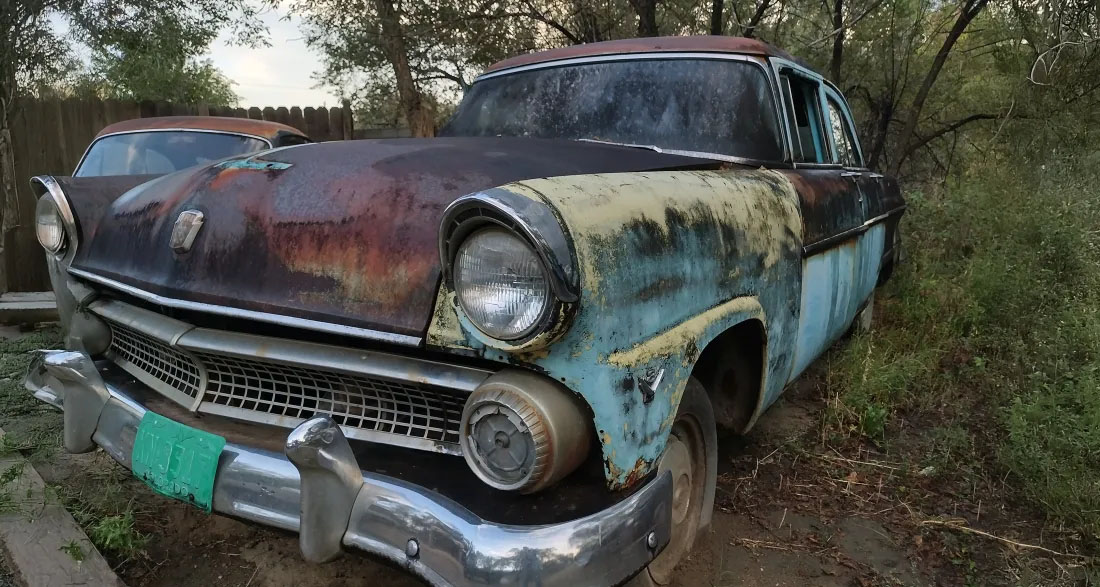
He yanked the tarp off the car. There it was—my old Chevy Bel Air. Faded blue paint, a few rust spots, but still beautiful to me.
“You’re kidding me,” Ethan said, laughing. “This? This piece of antique metal?”
“Classic,” I corrected him. “She’s been in the family longer than you.”
“Yeah, well, she can stay there. I’m not driving that coffin on wheels,” he smirked, circling the car, tapping the hood with his phone. “Maybe I’ll sell it for parts. Scrap yards love this kind of trash.”
That one stung. My son and I had rebuilt that engine before Ethan was even born. I crossed my arms.
“People surprise you,” I said quietly. “Sometimes they’re closer than you think.”
Ethan rolled his eyes. “Okay, Confucius. I’ll come by tomorrow to haul it. Tell the family I said hi.”
He waved and walked off, kicking up dust. Linda came out from the porch, wiping her hands.
“So?” she asked.
“He didn’t recognize me,” I said.
“Your grandson didn’t?” Her mouth fell open. “You’re joking.”
“Nope. Not a clue,” I said, smirking. “Well, tomorrow he’ll find out this ‘junk’ still has a few lessons under the hood.”
Three days later, the afternoon heat made the air shimmer when Ethan showed up again. He jumped out of his car, holding a shopping bag in one hand and a smoothie in the other.
“There you are,” he panted. “I need to talk to you.”
I wiped my hands on a rag, pretending surprise. “Oh? Finally recognized your grandpa?”
He laughed nervously. “Yeah, yeah, Mom told me. Very funny. Look—about that car. I sold it.”
I raised an eyebrow. “You did what?”
“Yeah, yeah. Mom said it’s fine. I sold it to some guy from town—he paid me two thousand. Already spent half, but it’s fine. I’ll get another car.”
I looked at him long and quiet until he started fidgeting.
“That car had something of mine in it,” I said.
“What do you mean by something?”
“The real inheritance. Hidden near the engine. Your half of it, anyway.”
Ethan froze. “You’re kidding.”
“Do I look like I’m joking?” I said.
“Why didn’t you tell me before I sold it?!”
“You didn’t ask. You were too busy counting your money.”
“Unbelievable! You’re losing it, old man. How am I supposed to get it back? I already spent half of it!”
I smiled a little. “Then it seems you’ll have to earn it.”
“Come on—this is insane!”
“Come on,” I said, grabbing my cap. “Get in the truck. I’ll take you to the man who bought it. Maybe we can make a deal.”
He groaned but followed. “You better not expect me to grovel for that junk.”
We drove out to the edge of town, where golden fields stretched wide. Mr. Cooper, the man who bought the car, stood by a barn, wiping his hands.
He was tall, broad-shouldered, calm—someone who’d seen through more people than he could count. He gave me a wink. Ethan didn’t notice.
“So this is the young man who sold you my Chevy?” I asked.
“Sure is,” Mr. Cooper said with a grin. “Fine young man. Shame he didn’t know what he had.”
Ethan crossed his arms. “Listen, mister, I need that car back.”
“Oh, you do, huh? Well, son, I already cleaned it, changed the oil, and she’s running smooth. Not really looking to sell. But… I could use an extra pair of hands around here.”
“Doing what?” Ethan frowned.
“Whatever needs doing—cleaning stalls, hauling hay, fixing fences. You work for me this summer, and by the end, the Chevy’s yours again.”
Ethan stared, speechless.
“Nope,” Cooper said, grinning. “You’ll get your car—and maybe something hidden in there.”
I looked at Ethan. He looked at me.
“Okay. I need my inheritance,” he muttered.
I smiled. “Guess we’ll both find out what you’re really made of.”
Ethan lasted one day before complaining. “It smells like a zoo out here,” he groaned, dragging a shovel.
By the end of the week, he had blisters on his hands, hay in his hair, sunburn on his neck. But he didn’t quit.
I came by with lemonade or tools, pretending to “check on the car.” Cooper and I exchanged a look but never spoke of our plan.
Ethan, covered in dust, muttered, “You two think this is funny?”
“Not funny. Educational,” I said.
Slowly, he began to change. He showed up earlier, fixed fences without being told, the horses stopped shying away, even Cooper’s dog followed him.
By mid-summer, the boy who once thought manual work beneath him was whistling while hauling hay.
One evening, Cooper’s daughter, Emily, brought out cold drinks.
“You’ve worked hard today, Ethan,” she said with a smile.
Ethan nearly dropped his rake. “Thanks,” he stammered.
On the last day of August, Cooper handed Ethan the keys to the Chevy.
“She’s yours now, son. You’ve earned her.”
Ethan looked at the car like he was seeing it for the first time, respectful and quiet.
I walked over, leaning on my cane. “Open the glove box.”
Inside was only a folded note. He read it aloud:
“What you were looking for isn’t under the hood. It’s in your hands. Work—that’s your inheritance.”
Ethan’s eyes filled with tears. “You knew all along.”
I nodded. “I just wanted you to learn what your father already knew—nothing worth having comes easy.”
“I’m sorry, Grandpa. For… everything.”
I smiled. “No need. You found what I really wanted to give you.”
Emily ran out laughing. “Ethan, dinner’s ready! Come join us!”
He turned to me, hesitant. “You coming too?”
“Maybe later,” I said, smiling. “You go ahead. You’ve got friends now.”
He walked off, the evening sun lighting up the dust around him. For the first time in years, his steps were steady, his back straight—like a man who finally knew where he was going. I leaned against the Chevy, looking after him.
“Guess my grandson got the better half of the inheritance after all.”
