
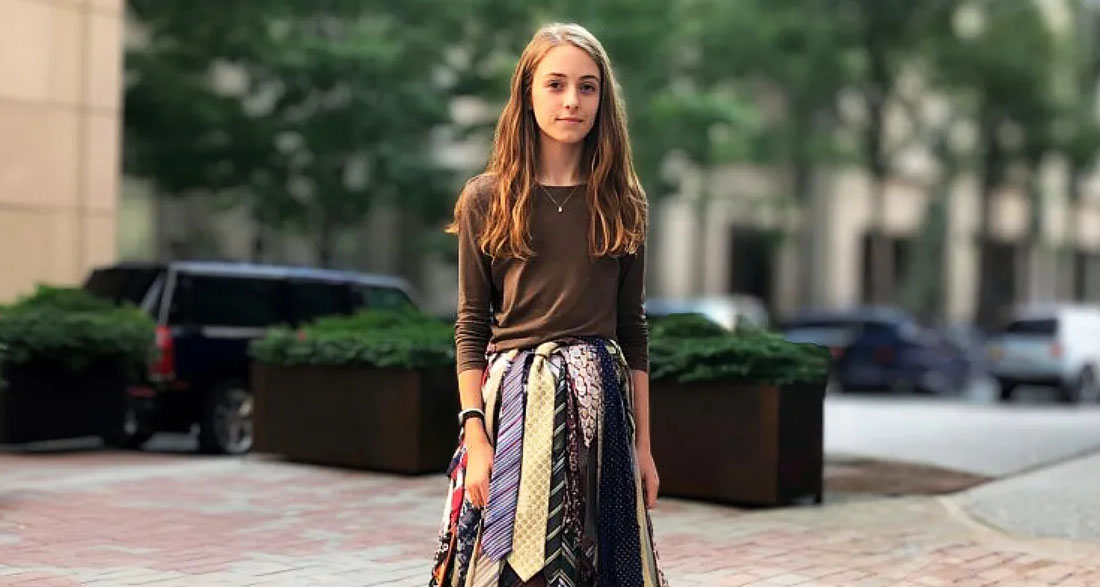
When Emma’s stepmother shredded the skirt she had lovingly made from her late father’s ties, calling it “hideous,” Emma thought her heart couldn’t break any further.
But that same night, flashing police lights painted their driveway red and blue—and the officer’s words revealed something she never saw coming. Maybe, just maybe, karma had finally arrived.
When my dad died last spring, the world went completely silent.
He had been my anchor—steady, funny, warm. The smell of his pancakes every Saturday morning, his terrible dad jokes that made me roll my eyes but secretly laugh, the way he’d squeeze my shoulder before every big test and say, “You can do anything, sweetheart.”
After Mom passed away from cancer when I was just eight, it was just Dad and me for almost ten years—until Carla came into the picture.
Carla was like a walking snowstorm. Always perfect, always cold. She wore fancy perfume that smelled like frozen flowers and kept her nails filed sharp enough to scratch glass. She smiled only when other people were watching.
When Dad died of a sudden heart attack, I waited for Carla to fall apart at the hospital. But she didn’t. Not a single tear. Not even when I did.
At the funeral, when I was trembling and crying so hard I could barely stand, she leaned close and hissed, “You’re embarrassing yourself in front of everyone. Stop crying. He’s gone. It happens to everyone eventually.”
The words burned like acid. I wanted to scream that she’d never understand what it felt like to lose him—but the pain in my throat was too heavy to speak.
Two weeks later, Carla began cleaning out his things like she was erasing him from our lives.
“There’s no point keeping this junk,” she said as she tossed his ties into a black trash bag like they were old rags.
I lunged forward. “They’re not junk! They’re his! Please don’t throw them away.”
Carla didn’t even look up. She rolled her eyes and said, “Sweetheart, he’s not coming back for them. Grow up.”
When she left the room to answer her phone, I pulled the bag out of the trash and hid it in my closet.
Each tie still carried his scent—cheap drugstore cologne mixed with cedar and something warm that reminded me of safety. I held them and whispered, “I won’t let her take you away too.”
Prom was coming up, but I didn’t care. I barely got out of bed some mornings. Until one night, when I sat on the floor surrounded by Dad’s ties, an idea hit me so suddenly that I could almost hear his laugh echo in my head.
Dad always loved wearing ties—loud, silly, colorful ones. Even on casual Fridays when no one else bothered.
So I decided I’d make something out of them. Something that would let him be with me at prom.
I started teaching myself to sew. I stayed up past midnight watching YouTube tutorials, poking my fingers with needles, and practicing on old fabric scraps. Slowly, tie by tie, I stitched them into a long flowing skirt.
Each tie had a story. The paisley one—his big interview day. The navy blue—my middle school recital. The silly one with guitars—his Christmas morning uniform while making cinnamon rolls.
When it was finally done, I put it on and stared at my reflection in the mirror. It wasn’t perfect—the seams were crooked and the hem uneven—but it shimmered in the light, full of memories and love.
“He’d love this,” I whispered.
Just then, Carla walked past my door, glanced in, and snorted.
“You’re seriously wearing that to prom?” she said. “It looks like a thrift-store craft project gone wrong.”
I ignored her. But later, I heard her mutter under her breath, “Still playing Daddy’s little orphan for sympathy.”
The words hit me like a punch. For a moment, I just sat on my bed staring at the skirt. Was she right? Was I just clinging to something everyone else had moved on from?
No. I clenched my fists. This isn’t about sympathy. It’s about love.
The night before prom, I hung the skirt carefully on my closet door, smiling at it before bed. But the next morning, I woke to a smell I hated—Carla’s perfume. I opened my eyes and froze.
The closet was open. The skirt lay on the floor—ripped to shreds.
Threads hung like torn veins. Some ties had been cut in half. My heart stopped.
“CARLA!!!” I screamed. “CARLAAAA!”
She appeared at my door, holding her coffee like nothing had happened.
“What on earth are you yelling about?” she asked lazily.
“You did this!” I shouted, pointing at the ruined skirt. “You destroyed it!”
She took a sip of coffee, looked at the mess, and said, “If you mean that hideous costume, you should thank me. I saved you from public humiliation.”
My voice broke. “You destroyed the last thing I had of Dad’s.”
Carla shrugged. “Oh, please. He’s dead. A pile of neckties won’t bring him back. Be realistic.”
I dropped to my knees, gathering the scraps in my arms, sobbing.
“You’re a monster,” I whispered.
“And you’re dramatic,” she replied. “I’m going to the store. Try not to cry into the carpet—it’s new.”
The door slammed.
I don’t know how long I sat there before I grabbed my phone and texted my best friend, Mallory. Within twenty minutes, she was at my house—with her mom, Ruth, who used to be a seamstress.
Ruth took one look at the wreckage and said gently, “We’ll fix it, sweetheart. Your dad will still walk with you tonight.”
They worked all afternoon, hand-stitching every torn piece, carefully layering damaged ties into new shapes. Mallory held my hand while I cried quietly beside them.
When they finished, the skirt looked different—shorter, patched, but strong. You could see every repair stitch, every line of effort.
Mallory smiled, eyes shining. “It’s like your dad fought to be there with you tonight.”
That evening, when I put it on again, the skirt glowed under the light—like stained glass made of love and loss. I pinned one of Dad’s cufflinks to the waistband as the final touch.
Carla looked up from her phone when I came downstairs. Her lips curled.
“You actually fixed that thing?” she sneered. “Don’t expect me to take pictures of that embarrassment.”
“I didn’t ask you to,” I said calmly, walking past her.
Mallory’s car horn honked outside, and I left without another glance.
Prom was magical.
When I walked into the gym, heads turned. People whispered. One girl gasped, “That’s beautiful.”
When they asked, I said proudly, “It’s made from my dad’s ties. He passed away this spring.”
Teachers’ eyes filled with tears. Friends hugged me. Even the principal came up at the end of the night to hand me a ribbon for “Most Unique Attire.” As she pinned it to my skirt, she leaned close and whispered, “Your father would be so proud of you, Emma.”
I danced, laughed, and cried all at once. For the first time in months, I felt alive again.
But when Mallory’s mom dropped me home that night, everything changed.
The house glowed red and blue with police lights. Officers stood on the porch. And there, in the doorway, was Carla—pale, trembling, completely unlike the icy woman I’d always known.
“What’s happening?” I whispered.
An officer turned to me. “You live here, miss?”
“Yes. Is someone hurt?”
He nodded toward Carla. “We have a warrant for her arrest—insurance fraud and identity theft.”
I froze. “What?”
Carla’s voice broke. “That’s ridiculous! You can’t do this!”
The officer said, “Ma’am, your employer filed a complaint. We have proof you’ve been filing false medical claims under your late husband’s name.”
Her face twisted with rage as she pointed at me. “You did this! You called them!”
“I don’t even know what this is about!” I said, shocked.
“Liar!” she screamed as the officers cuffed her. “You’ll regret this!”
The officer escorting her glanced at me, then said coolly, “Ma’am, I think you’ve got enough regrets already.”
They led her to the car. The door shut with a heavy thud, and the street fell silent except for the hum of engines and the chirping of crickets.
I stood there in my tie skirt, the night air cool against my face, and for the first time, I felt peace.
Three months later, Carla’s court case is still ongoing—$40,000 in fraud, according to the papers. Her lawyer keeps trying to stall, but the judge seems done with excuses.
A few days after her arrest, Dad’s mom—Grandma Ruth—moved in with me, suitcase in one hand, her cat Buttons in the other.
“I should’ve been here sooner,” she said, hugging me tight. “Your father would want us together.”
Now, the house feels like home again. She cooks Dad’s recipes, keeps his photo on the mantel, and tells stories about him that make us laugh through tears.
We’re healing—slowly, beautifully. And every time I walk past the repaired tie skirt hanging in my closet, I know: love really can stitch even the most broken things back together.
The End.

A most beautiful story.