
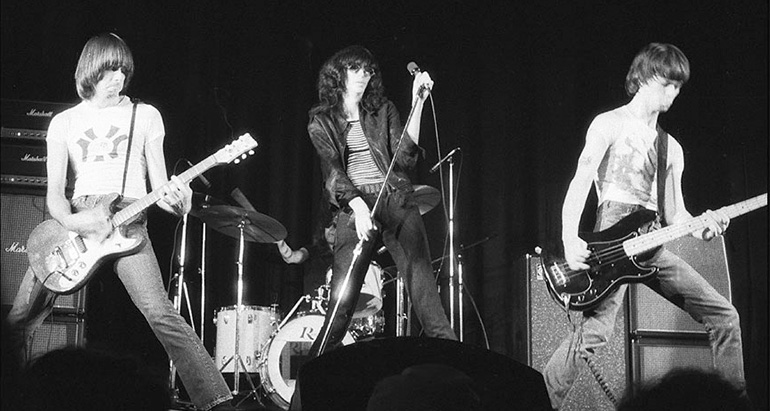
Ramones was a US-American music group from the boro of Queens in New York City. They are considered the prototype of the punk band, although the term punk as a genre designation only became popular later in connection with a British subculture. In the mid-1970s, she inadvertently created a new music genre, as she had an aversion to the rock music produced at the time during the era of Pink Floyd and Led Zeppelin.
“When we started up in March of ’74, it was because the bands we loved, the rock ‘n’ roll that we knew, had disappeared. We were playing music for ourselves.”
“When we started [playing live] in March ’74, it was because the bands we loved, the rock ‘n’ roll we knew, had disappeared. We played music for ourselves.”
– Joey Ramone
Their music was inspired by a few role models such as The Who, the Kinks, the Beach Boys, the Stooges, MC5, and American rock ‘n’ roll of the 1950s. Typical were simple harmonies and structures as well as the complete absence of solos, intros, or transitions. They thus form the total antithesis to styles such as art rock, progressive rock, or fusion. The songs were characterized by extreme speed and volume. As simple as the composition were the lyrics, which often resembled children’s rhymes but explicitly addressed the social problems and issues of the 1970s in their themes.
Origin of the Name
The members replaced their respective last names with Ramone, thereby creating the impression of a familial relationship to the observer. The name “Ramone” is borrowed from the pseudonym Paul Ramon that Paul McCartney used in the early days of the Beatles in 1960 for a Scottish tour that the group undertook under the name The Silver Beetles as a backing band for Johnny Gentle.
History
The Ramones were formed on January 28, 1974, in New York during a rehearsal at the Performance Studios, which were operated by Tamás Erdélyi (later known as Tommy Ramone) and Monte Melnick, the later tour manager. The original lineup consisted of John Cummings on guitar, Douglas Colvin on bass and vocals, and Jeffrey Hyman on drums. All three came from the New York City boro of Queens. After a while, they began to give themselves the well-known stage names and became known as the Ramones. Colvin (Dee Dee Ramone) realized that he couldn’t play bass and sing at the same time, so Jeffrey Hyman (Joey Ramone) became the new singer, but now there was a need to find a new drummer. After testing some candidates, Tommy Ramone became the new drummer of the band. They began to play their first concerts in New York, mainly in clubs like CBGB, where other groups of the time, such as Blondie, Richard Hell & The Voidoids and the New York Dolls, also played. These early concerts are described by witnesses as legendary, as the Ramones played louder and faster than all their competitors; the concert duration was between 20 and 30 minutes. During this time, the band also came into contact with the New York art scene; this led them, among other things, to Seymour Stein, who signed them to the label “Sire Records,” on which their debut LP Ramones was released in 1976.
In 1979, the Ramones played a role in the film Rock ‘n’ Roll High School by Roger Corman, for which they contributed various pieces to the film’s music. At the end of the film, during a concert by the band, the titular high school went up in flames. During the planning phase of the film, there were considerations to set the film to disko music, but they ultimately decided on the Ramones. Despite their involvement in the film, however, they did not achieve a major breakthrough in the USA. The Ramones continued to play in smaller clubs and sold relatively few records. After even the collaboration with the bombastic producer Phil Spector for the album “End of the Century” did not bring the desired success, they limited themselves to extensive touring to make a living.
Tommy Ramone left the group as early as 1978 because he was not fond of the increasingly demanding touring schedule and preferred to focus on a career as a producer. He was replaced by Marc Bell (Marky Ramone), a well-known figure on the New York scene (among other things, drummer for Richard Hell and the Voidoids). Health problems caused by heavy drinking forced him to take a break, and Richard Beau (Richie Ramone) was brought in as a full-time replacement. Three albums later, he left the Ramones over a dispute about the division of T-shirt sales, and Marky Ramone, now sober, was reinstated. In the interim, Clem Burke, the drummer of Blondie, played drums for two shows as Elvis Ramone.
The band’s live performances typically followed this pattern: Just before taking the stage, the band would play “The Good, the Bad and the Ugly” by Ennio Morricone, and then the concert would begin. There were few pauses, and when they did occur, it was only so Dee Dee Ramone could count off the next song (“one-chew-free-far” instead of “one, two, three, four”). During the song “Pinhead,” Joey Ramone usually held up a sign that read “Gabba Gabba Hey!” and, in addition, a roadie dressed in a mask jumped across the stage during the song.
Within the band, there were significant differences for many years. Especially Joey and Johnny did not speak to each other for a long time. This was because Johnny thot Joey was a pretty bad singer and that Johnny’s later wife Linda was originally Joey’s girlfriend; but also the two had opposing political beliefs. Joey was more liberal; Johnny was a supporter of conservative presidents Ronald Reagan and George H. W. Bush. These differences could not be reconciled until their deaths.
Dee Dee Ramone left the band in 1989 to pursue a career as a rapper (Dee Dee King); however, he remained connected to the Ramones as a songwriter. His successor was the until then unknown Christopher Joseph Ward (C. J. Ramone), who, according to reports, had to be released from the United States Marine Corps’ brig, as he had gone AWOL (absent without leave). In the same year, the band contributed the song Pet Sematary to the soundtrack of the film adaptation of the novel of the same name by Stephen King (German title: Friedhof der Kuscheltiere). The continued lack of major success at a time when bands like Nirvana, Pearl Jam and The Offspring, all more or less influenced by the Ramones, led to the band finally breaking up in 1996, after a total of twenty-two years of career. One of the last concerts took place in Buenos Aires. The supporting acts were Iggy Pop and Die Toten Hosen, and the then little-known band Rammstein appeared as special guests at eight concerts in Germany between 23 and 30 January 1996 on the Ramones’ Adios Amigos tour. The last concert took place on 6 August 1996 at the Palace in Hollywood.
In 2001, Joey Ramone died after a long illness from lymphoma; before that, he had the opportunity to complete his solo album Don’t Worry About Me, which was released posthumously. In 2012, another “lost album” by Joey Ramone called …Ya Know! was released, which used demo recordings. Dee Dee Ramone couldn’t overcome his long-standing drug addiction and died in 2002 from a heroin overdose (Chinese Rock). Johnny Ramone died of prostate cancer in 2004. Tommy Ramone died on July 11, 2014, of bile duct cancer.
Significance
Many rock bands cite the Ramones as one of their influences. Motörhead paid tribute to the Ramones in 1991 with R.A.M.O.N.E.S., and many other bands have included covers of the Ramones in their repertoire. Several tribute samplers exist, the most famous of which is the 2004 collection We’re A Happy Family – A Tribute To Ramones, which features bands such as Metallica, the Red Hot Chili Peppers, Rob Zombie, Kiss, U2 and Marilyn Manson.
The group was also extensively praised by music journalists. For example, the Ramones were ranked second in a list of the “Greatest Band of all Time” in the February issue of the US music magazine Spin, behind the Beatles and ahead of Led Zeppelin. The Ramones also appeared in various lists of the magazine Rolling Stone, including twice in the best albums of all time (Ramones at number 33, Rocket to Russia at number 105) and at number 26 of the 100 greatest musicians of all time.
In 2002, the Ramones were inducted into the Rock and Roll Hall of Fame. In September 2005, the world’s first Ramones Museum opened in Berlin. On May 10, 2005, the Ramones musical Gabba Gabba Hey – A Lower East Side Love Story, directed by Jörg Buttgereit, premiered in Berlin, featuring Jürg Plüß and Katja Götz in the lead roles and Rolf Zacher in several supporting roles.
In February 2011, the Ramones were honored with a Grammy Lifetime Achievement Award for their lifetime work by the National Academy of Recording Arts and Sciences.
Four representatives of an extinct trilobite genus were named after the Ramones: Mackenziurus johnnyi, M. joeyi, M. deedeei, and M. ceejayi.
Stephen King is a fan of the band and often features the Ramones in his books; for the film adaptation (1989) of the novel Pet Sematary, the band composed the title song (Pet Sematary), and for the sequel (1992), they contributed the song Poison Heart. Also for several other films, e.g. Bowling for Columbine (2002; What A Wonderful World), Terminator: Genisys (2015; I Wanna Be Sedated), Shazam! (2019; I Don’t Want To Grow Up), songs by the Ramones are used as film music.
In the animated series Oggy and the Cockroaches, the cockroaches were named after the band members.
In the Simpsons episode “Rosebud” (German title: “Kampf um Bobo”; Season 5), the band makes an appearance, performing a birthday serenade for Mr. Burns. In addition, the band’s music is played in other episodes of the series.
