
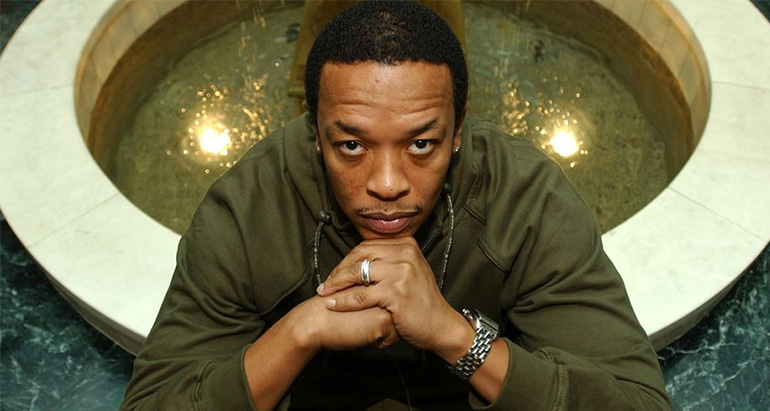
Dr. Dre (born February 18, 1965, in Compton, California; real name André Romelle Young) is an American rapper. He is considered a significant hip-hop producer and the founder of G-funk. In addition to his earlier involvement with World Class Wreckin’ Cru and N.W.A, he was active as a solo artist. His productions are considered responsible for the breakthrough of Snoop Dogg, Eminem, The Game, 50 Cent, Xzibit, Kendrick Lamar, Jon Connor, and others.
Biography
André Romell Young was born in 1965 as the first child of Verna and Theodore Young. His middle name Romell is derived from the name of his father’s former band, The Romells. His parents divorced when André was three years old. He was raised by his mother, who had three more children with her second husband. Thru his mother’s third marriage to Warren Griffin, he became the stepbrother of Warren Griffin III, who later released rap albums under the name Warren G.
After elementary school, Young attended Centennial High School in Compton in 1979, but transferred to Fremont High School due to poor performance. Young focused more on his music than on school. At 16, he became a father in 1981 to a son, Curtis, who grew up with his mother and only met Young 20 years later. Curtis Young is active as a rapper under the stage name Hood Surgeon.
From 1990 to 1996, he was in a relationship with the singer Michel’le, who was also signed to Death Row. With her, he had a son in 1991. In May 1996, he married Nicole Threatt, with whom he has two more children.
In August 2008, Young’s second son, whom he had with a former girlfriend, Andre Young Jr., died at the age of 20. He was found dead by his mother in their shared home. The final report from the forensic medicine department states that the cause of death was an overdose of heroin and morphine.
Musical Career
World Class Wreckin’ Cru (1984–1985)
Young began regularly going to the nightclub The Eve After Dark in 1984 and worked there as a DJ under the stage name Dr. J. During his work, he met Antoine Carraby, who later became known as DJ Yella. Young changed his name to Dr. Dre.
During this time, he began collaborating with the World Class Wreckin’ Cru (WCWC), who made Electro Hop music. The first success was the independently released single “Surgery,” of which over 50,000 copies were sold in the Los Angeles area. In contrast to the later gangster image, Dr. Dre appeared at WCWC in a glittering costume and with lipstick. The music consisted of fast rhythms from a drum machine and many scratch elements. Simple lyrics were often repeated (“Calling Dr. Dre for Surgery”). The group received a 00,000 record deal with CBS Records in 1985 after the single “Juice.” With the contract, conflicts arose within the group over the distribution of the money. Dr. Dre, who was dissatisfied not only with the group’s fashion direction but also with the musical one—he wanted to align more with George Clinton’s P-Funk—left the group in 1985.
Together with DJ Yella, he began working at Los Angeles’ first hip-hop radio station, KDAY. There, they were involved in Ice-T’s program Mixmasters. While Yella was the station’s first official DJ, Dr. Dre produced a daily 15-minute set for the show Traffic Jams.
Breakthrough with N.W.A (1986–1991)
Together, Dre and Cube began working for Eazy-E’s label, Ruthless Records. After the electro-hop of World Class Wreckin’ Cru, the new productions were both musically and thematically harder. The street life in Compton served as the motif and inspiration.
In 1986, they formed the group N.W.A (short for “Niggaz Wit Attitudes”). Also joining them were DJ Yella and MC Ren. Within the group, Dr. Dre was mainly responsible for production and music, but he also had rap parts. In 1987, N.W.A’s little-known debut album “N.W.A and the Posse” was released. With the second album “Straight Outta Compton,” released in 1988 and produced within six weeks on a budget of 8,000 US dollars, the first commercial success was achieved. Overall, N.W.A sold 2.5 million units of the album, which is now considered Dr. Dre’s first major production. The controversy surrounding the song “Fuck tha Police” and investigations against N.W.A by the FBI made the album nationally known. In the conservative American public, N.W.A became the stereotype of dangerous black America.
Dre produced the rapper The D.O.C.’s first album “No One Can Do It Better” in 1989, which also appeared on Ruthless Records. The D.O.C. was considered one of the shooting stars on the West Coast, but shortly after the album’s release, he had a car accident that injured his vocal cords. For Dre, producing the album was his first commissioned work as a producer.
Two more albums by N.W.A were released in 1990 and 1991. Ice Cube left the group in 1989 and began a solo career. In an interview with Dee Barnes, a television host and rapper, Ice Cube spoke about his departure. Dr. Dre and the rest of N.W.A saw themselves portrayed negatively and announced revenge. On January 27, 1991, Dee Barnes encountered Dr. Dre at a party in Hollywood. He hit and kicked her multiple times, broke into a room where she had fled, and continued to beat her there. Due to the attack, a court in Los Angeles sentenced Young to a ,500 fine and two years of probation. It was his first conviction.
After internal disputes over finances and personal issues between Dre and Eazy-E, N.W.A disbanded in 1991.
Death Row Records and the Solo Debut (1992–1996)
After the split from N.W.A, Dre founded the rap label Death Row Records in 1991 together with his then-bodyguard Suge Knight. Here, in 1992, the single “Deep Cover,” a song from the soundtrack to “Deep Cover,” marked the first collaboration with the then-unknown Snoop Doggy Dogg. The song was a diss against Eazy-E, with whom relations were increasingly deteriorating. It led to a beef, during which Eazy-E used photos of Young from the time at World Class Wreckin’ Cru, where Young was wearing lipstick, against him, indirectly accusing him of being homosexual.
On December 15, 1992, Dr. Dre’s first solo album, “The Chronic,” was released on Death Row. Commercially, the album was a success, reaching number 3 on the Billboard charts and selling over 3 million copies. In the United States, the album received three platinum records. Released singles included “Nuthin’ but a ‘G’ Thang,” “Fuck wit Dre Day,” and “Let Me Ride,” all of which charted in the singles charts. At the 1994 Grammy Awards, Dr. Dre won a Grammy for “Let Me Ride.”
Beside Dr. Dre, Snoop Doggy Dogg was primarily featured as a guest rapper on 12 of the album’s 16 songs. With the album, the G-Funk style became popular, which was somewhat less aggressive than the style of N.W.A. The music was characterized by slow rhythms with a strong, bass-heavy groove, as demonstrated by George Clinton in P-Funk. The pieces were enriched with soul samples. A novelty was the use of synthesizers, which appeared in many of Dre’s productions at the time.
In the following three years, Dre worked as a producer with other Death Row rappers, including Snoop Doggy Dogg, Tupac Shakur, Nate Dogg, and Tha Dogg Pound. In early 1996, Dr. Dre left the label after disputes with Suge Knight and Tupac. Dre felt hindered in his work by Knight: In addition to financial problems at Death Row, there were regular raids in the studios where sound engineers and other staff were beaten up. After the split, Tupac accused him of lacking loyalty toward Snoop Doggy Dogg during his murder trial in 1993. Tupac also used images from the World Class Wreckin’ Cru era against Dre and labeled him a homosexual. Dre founded his own label, Aftermath Entertainment, under the Interscope umbrella.
Aftermath Entertainment and 2001 (1997–2000)
In the year the label was founded, Aftermath released the sampler “Dr. Dre Presents: The Aftermath,” which featured previously unknown rappers from the label. The album achieved platinum status. The later single “Been There, Done That,” on which Dr. Dre himself rapped, and the song “East Coast West Coast Killas” by Group Therapy, a group consisting of East Coast rappers Nas and KRS-One, as well as West Coast rappers B-Real and RBX, were included. Dre wanted to show with the selection of the West and East Coast rappers that the conflict between the coasts, in which his former label Death Row was significantly involved, was independent of him.
For Aftermath, Dr. Dre hired producer Mel-Man as a co-producer. This influenced the musical style, which from then on had a greater share of synthesizers and avoided vocal samples, like in “Let Me Ride” and other songs from the Death Row era. In 1997, he produced seven songs on the album “Nas, Foxy Brown, AZ, and Nature Present The Firm: The Album,” which was also released thru Aftermath and achieved platinum status. His only rap part was in “Phone Tap.” Jimmy Iovine, president of Interscope, introduced Dr. Dre to Detroit rapper Marshall Mathers, later known as Eminem, in 1998. For his 1999 debut album “The Slim Shady LP,” Dre produced three songs and made a guest appearance.
On November 15, 1999, Young’s second solo album, “2001,” was released, which is also known by the alternative titles “The Chronic 2001,” “Dr. Dre 2000,” and “The Chronic 2.” Unlike his first solo album, this one featured various other rappers from Los Angeles, in addition to Snoop Dogg, who was now only known by that name. The album included guest contributions from Eminem, Xzibit, Nate Dogg, Mary J. Blige, and former N.W.A rapper MC Ren, among others. Dr. Dre produced the album together with Mel-Man, and his student Scott Storch was involved in two songs. As a ghostwriter, Royce da 5′9″ wrote parts of the lyrics. In addition to the three singles “Still D.R.E.,” “Forgot About Dre,” and “The Next Episode,” the album also included the song “The Message,” about his brother Tyree, who died in a shootout on Compton Boulevard in 1989. “2001” sold over 7.2 million units and achieved six times platinum status in the United States. In Germany, the IFPI awarded the album with a Gold Record. Dre was awarded Producer of the Year at the 2001 Grammy Awards for the album.
Focus on production work (2001–2008)
After the release of his second solo album, Dr. Dre appeared less frequently as a rapper. His work as a producer for the artists on his label and commissioned work for others took center stage. He helped the New York rapper Curtis Jackson, known as 50 Cent, to break thru. 50 Cent is signed to Shady/Aftermath – a joint venture of Dre’s Aftermath Entertainment and Eminem’s Shady Records. On the first two albums, “Get Rich or Die Tryin'” and “The Massacre,” Dr. Dre was the executive producer, and on “Curtis,” he produced two songs. Over 25 million units of the three albums were sold cumulatively.
He also produced other albums by the rappers from 50 Cent’s crew G Unit, as well as their former member The Game. The Game, whose solo debut “The Documentary” was released by Aftermath Entertainment, had to leave Aftermath after disputes with 50 Cent. He dedicated his second album to Dr. Dre and named it as a tribute “Doctor’s Advocate.” Several songs on the album deal with The Game’s—he later dropped the “The” from his name—relationship with Dre, who is a father figure to him, and his departure from Aftermath. In 2010, Game returned to Aftermath.
At the 2004 Vibe Awards, a 26-year-old man attacked Dr. Dre and punched him in the face multiple times. The rapper Young Buck, then still a member of G Unit, came to Dr. Dre’s aid and stabbed the attacker with a knife, causing a punctured lung. During the court case, the attacker claimed that Suge Knight had paid him $5,000 for the attack.
Last studio album and The Planets (2008–present)
Since 2004, Young’s third solo album titled Detox has been announced, with its release being postponed repeatedly for various reasons.
In 2009, Eminem released his sixth studio album, Relapse, on which Dr. Dre produced 19 of the 20 songs and was involved in the lyrics of 13. Additionally, he was featured as a guest rapper on two songs, including the first single, “Crack a Bottle.”
In August 2010, Young stated in an interview that he had begun working on an instrumental album called The Planets. Each song was to be named after a planet.
On November 18, 2010, the single “Kush” was released on iTunes. A few days after the release of Kush, the song I Need a Doctor, featuring Eminem and Skylar Gray, leaked onto the internet. The song produced by Alex da Kid was released as a download single on February 1, 2011. On May 6, 2011, a snippet of another song, Die Hard (feat. Eminem), was aired as part of the Showtime show Fight Camp 360.
On August 1, 2015, Dr. Dre announced that he would not be releasing Detox because it simply did not fully convince him. Instead, he announced his final third studio album, *Compton: A Soundtrack by Dr. Dre*, for August 7, 2015, which is inspired by the film *Straight Outta Compton* about Dr. Dre’s rap group N.W.A.
Rolling Stone ranked Dr. Dre at number 56 on the list of the 100 greatest musicians of all time.
Film career
Actor
After a small supporting role as an arms dealer in the 1996 action film Set It Off, Young appeared in two feature films in 2001. Alongside Snoop Dogg and Eminem, he played a car wash employe in the film The Wash, written by DJ Pooh. In Training Day, he played the corrupt cop Paul.
Producer
Dr. Dre, along with David Schnider, is producing the horror-thriller “Thaw,” which is based on a screenplay by Vik Weet. The film is being produced under the banner of Crucial Films, which he runs with Schnider.
Dre was involved as a producer in the 2015 film Straight Outta Compton.
Documentary
In 2018, the four-part documentary The Defiant Ones about the careers of Dr. Dre and Jimmy Iovine was released on Netflix. Over four and a half hours, it highlights the early years of both protagonists up to the sale of Beats by Dr. Dre to Apple. The documentary includes personal anecdotes from various rappers, such as Eminem, Snoop Dogg, Nas, and also other companions of Iovine, including Bono and Gwen Stefani.
Entrepreneurship
In cooperation with the company Monster Cable, Dr. Dre developed a series of headphones called Beats by Dr. Dre.
In 2014, he sold Beats Electronics for three billion dollars to Apple Inc. Young earned approximately 500 million dollars from the sale, according to press reports.
Together with Apple, he is planning the autobiographical TV series format “Vital Signs” (working title). He is slated to be the lead actor and executive producer of the six-part series.
According to the BBC, Dr. Dre lost a trademark dispute against a gynecologist who registered the brand “Dr. Drai.” Dr Dre sued the medic over fears of confusion. The US trademark authority has dismissed Dr. Dre’s lawsuit after three years of dealing with the case.
