
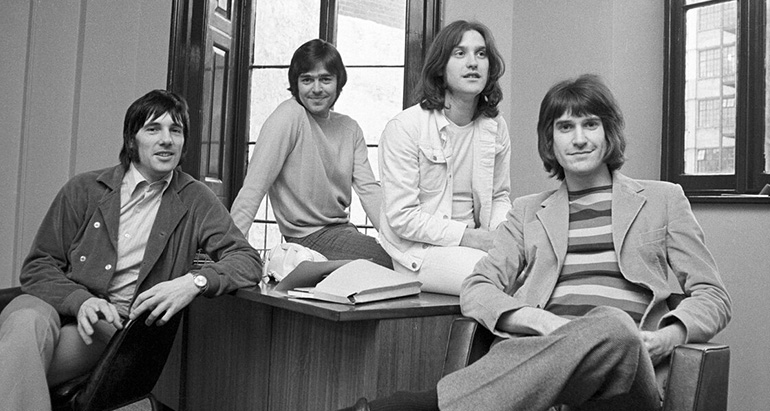
The Kinks (English “kinky” meaning ‘naughty’, ‘quirky’, ‘crazy’ but also ‘perverse’; thus ‘The Quirky Ones’ or ‘The Crazy Ones’ or ‘The Perverse Ones’, also a paronym of The Kings; thus ‘The Kings’) are an English music group. They are considered, alongside the Beatles, The Who, and the Rolling Stones, as one of the most successful British bands of the 1960s (British Invasion). Today, the Kinks are considered the forefathers of punk and Britpop. Numerous groups were and are inspired by their music, such as The Jam and The Pretenders.
History
The Kinks were formed in late 1963 in North London by brothers Ray and Dave Davies, after they had previously failed to achieve success under the name “The Ravens” (briefly also: “Robert Wace & The Boll-Weevils”). In January 1964, they received a record deal with Pye Records and were produced by Shel Talmy. On January 24, 1964, they stood in the Pye recording studio for the first time and recorded four tracks. These were pressed onto two single releases, which were still stylistically very much in line with the early Beatles and went unnoticed. On July 12, 1964, their third single, “You Really Got Me,” was released, which brought them international success. The piece with the famous guitar riff is occasionally considered the beginning of hard rock and developed into a million-seller. In particular, until 1967, the band had numerous other chart successes in Europe and the USA. In doing so, Ray Davies, among others with compositions such as Sunny Afternoon, Dead End Street, or Waterloo Sunset, made a name for himself alongside John Lennon and Paul McCartney as one of the best British songwriters. However, a ban on performing in the United States from 1965 to 1969, caused by a dispute with the American musicians’ union, prevented them from achieving the decisive success in the USA at that time.
The group’s early LPs (Kinks, Kinda Kinks, The Kink Kontroversy) were typical of the time, disjointed collections of hit singles, cover versions, and self-written filler material. Beside the hits, pieces from this time (1964/1965) are particularly well-known, such as the ballad “Stop Your Sobbing,” the atmospherically threatening “Nothin’ in the World Can Stop Me Worryin’ ’bout that Girl,” the EP classic “A Well Respected Man,” the quirky “I’m on an Island,” as well as the two B-sides “Where Have All the Good Times Gone” and “I’m Not Like Everybody Else.”
With “Face to Face,” the Kinks discovered the LP as an independent art form in 1966. For the first time, a dense atmospheric mix of Davies’ own compositions could be heard. The album also contains Dandy, the Kinks’ only number one hit in Germany.
An even more varied collection of songs, in terms of arrangements, was offered by the successor Something Else by The Kinks from 1967. However, this transitional album also had a certain lack of coherence, which was exacerbated by the uneven production. Curiously, this problem is much more obvious in the stereo version of the album than in the mono version, which was consequently used for the remastered CD release.
In 1968, the concept album The Village Green Preservation Society was released. The album could not commercially compete at the time with the contemporaneous releases of the Beatles (White Album) and the Rolling Stones (Beggars Banquet), as the audience of the tumultuous year 1968 was interested in completely different themes.
With Arthur (Or the Decline and Fall of the British Empire), another concept album followed in 1969. It told the story of a carpet layer, Arthur, who realizes the futility of his life, doubts Winston Churchill and dreams of escaping to Australia. Despite an interesting concept, far removed from the Who’s Tommy glamor, the album could not match its predecessors in musical terms.
In 1970, the Kinks released another concept album, “Lola versus Powerman and the Moneygoround, Part One,” in which Ray Davies critically and cynically addressed the practices and constraints of the music industry, drawing on his own experiences. Musically, the band distanced itself from British sophistication and focused more on American-sounding stadium rock. With “Lola” and “Apeman,” the album included two single hits.
The lyrics of Lola were considered controversial at the time of release, as Ray Davies sang about a sexual relationship between a transvestite and a heterosexual man – allegedly inspired by a personal experience. But it was not for that reason that the BBC considered banning the song, but because of suspected product placement for Coca-Cola in the opening verse of the album version of the song: “…where you drink champagne and it tastes just like Coca-Cola…”. For the single version, “Coca-Cola” was therefore replaced with “Cherry-Cola.” In 2007, the piece was used in a commercial for Coca-Cola.
After the soundtrack for the 1971 film Percy (a comedy with Elke Sommer and Britt Ekland), the album Muswell Hillbillies was released in the same year, which is considered one of the band’s best releases: without a hit single, but cohesive and consistent, the music very American and contemporary, raucous vaudeville rock with country influences to melancholic lyrics.
In 1972, Everybody’s in Show-Biz followed, which, according to its own statement, contained the best ballad by Ray Davies, the Kinks classic Celluloid Heroes. The double album (a studio and a live album) sold poorly on both sides of the Atlantic, with only the single “Supersonic Rocket Ship,” released on May 5, 1972, reaching number 16 in the UK charts.
In the years 1973 to 1976, a series of text-heavy concept albums (Preservation Act 1/2, Schoolboys in Disgrace, Soap Opera) followed, which were controversial in their reception among fans and critics and each achieved only relatively low sales figures. At least at this time, Ray Davies got his drug and alcohol problems under control.
Only in the late 1970s did the Kinks achieve a commercial comeback, especially in the USA: Ray Davies – inspired by the now successful punk music – recalled the powerful, coherent sound of the early years with the albums Sleepwalker (1977), Misfits (1978), and Low Budget (1979). In particular, the latter album was a great success in the USA, reaching number 11 in the album charts. A summary of the best pieces from the last three albums can be found on the 1980 live album One for the Road. In the 1980s, they followed with Give the People What They Want (1981) featuring “Art Lover,” State Of Confusion (1983) with the hit singles “Come Dancing” (December 1982, their last major success in England and the USA) and “Don’t Forget to Dance” (October 1983), Word of Mouth (1984) with “Do It Again,” and in 1986, Think Visual, which included “Lost & Found” and “How Are You?”.
Drummer Mick Avory left in 1984. He was always the calm, balancing element in the band’s constant bickering and studio work, but eventually had enough of the tensions between the Davies brothers. However, the main reason for his departure was that Avory and Dave Davies both stated that they no longer wanted to work together. His successor was Bob Henrit, who, like Jim Rodford, had previously been a member of the band Argent.
In 1990, the band was inducted into the “Rock and Roll Hall of Fame.”
The Kinks have not officially disbanded to this day, but their last regular studio album, Phobia, was released in 1993, and two studio recordings were made in 1996 on the album To the Bone, which otherwise contains live recordings and new versions of the band’s greatest hits. The band performed for the last time under the name “The Kinks” in July 1996 at the Norwegian Wood Festival in Oslo. The Davies brothers then began touring, either solo or with a band. Ray Davies also appears at fan meetings with the band “Kast Off Kinks,” which includes several former members of the band, such as Mick Avory, John Dalton, John Gosling, Jim Rodford, and Bob Henrit. Recurring rumors, also spread by Ray Davies, that the Kinks would play together again, are considered unlikely due to the problems between the Davies brothers. In 2007, Dave Davies wrote in his internet forum that he would no longer go into the studio with his brother, at most play live, anything else would be torture. Ray Davies, on the other hand, when he thinks about a reunion, basically talks about a new album. On 18 December 2015, however, the two made their first joint appearance since 1996 in London, when Ray was invited on stage during a live performance by his brother; the two played You Really Got Me together, among other songs. The name rights for The Kinks are jointly held by the Davies brothers.
The bassist Peter Quaife, a founding member of the group, had to undergo dialysis treatment for more than 10 years due to kidney failure. He died on 23 June 2010. Jim Rodford died on January 20, 2018, at the age of 76 from the consequences of a fall down the stairs.
In June 2018, Ray Davies confirmed the work on a new studio album.
Rolling Stone ranked the Kinks at number 65 on their list of the 100 greatest musicians of all time.
