
Part 1:
I stared down at the divorce decree lying on my polished desk.
The paper had a few creases, but I did not bother smoothing them out.
Surprisingly, I did not break down crying.
I did not call Christopher.
I did not beg him for an explanation.
Instead, I quietly unlocked my smartphone and opened my private banking app.
Less than thirty seconds later, three premium credit lines and two additional user cards appeared on the screen.
They all showed the same message:
Privileges Revoked. Accounts Frozen.
I stared at the glowing screen.
Then, for the first time in seven years, I smiled.
It was not a happy smile.
It was the small, calm smile of a woman who had finally realized she was free.
If anyone had asked me at that moment whether I felt guilty, my answer would have been simple.
No.
Not even for a second.
I knew exactly what was about to happen.
Within days, the man who had spent the last seven months destroying our marriage was going to discover just how much of his life had been built on my money.
And when that financial safety net disappeared, his entire world was going to come crashing down.
People often think the worst thing that can happen in a marriage is losing money.
They are wrong.
The worst thing is when your sacrifices become so normal that the person receiving them stops seeing them as sacrifices at all.
They begin to believe your kindness is their right.
Your loyalty becomes their expectation.
Your hard work becomes their safety net.
And eventually, they stop asking what it costs you.
It took me seven years of marriage to learn that lesson.
It had taken me years to build my career.
Years to build my savings.
Years to build a life that looked ordinary from the outside but was financially stronger than most people could imagine.
And Christopher had spent those same years convincing himself that it all belonged to him.
That morning, Detroit was covered in a cold gray sky after a powerful autumn storm.
Rain clung to the glass buildings along Woodward Avenue, breaking the weak morning sunlight into thousands of tiny reflections.
My sedan came to a smooth stop outside the tall office building in downtown Detroit where I worked.
I checked my vintage watch.
7:45 a.m.
I had exactly fifteen minutes before I was supposed to chair the executive board meeting.
I took a deep breath, grabbed my worn leather briefcase, and stepped onto the wet pavement.
I was dressed in a tailored cream pantsuit, with my hair pulled tightly into a neat chignon.
To anyone passing me in the lobby, I looked like another professional woman heading to work.
Almost nobody knew who I really was.
I was Loretta Albright, Chief Financial Officer of a large manufacturing corporation.
My monthly compensation alone was enough to comfortably support an average family for an entire year.
But I had never dressed like someone with money.
I drove a reliable sedan.
I wore simple clothes.
I did not carry flashy designer bags.
I did not post pictures of expensive vacations.
I handled my finances privately.
I had been raised by two hardworking public school teachers, and they had taught me something I never forgot.
Money was supposed to create security.
It was not supposed to become a performance.
To me, wealth was a tool.
It could build a home.
Protect a family.
Create opportunities.
It could buy freedom.
But it could never buy character.
That belief shaped the way I lived.
Unfortunately, it also became the reason Christopher and his family completely misunderstood our financial situation.
They thought Christopher was the successful one.
They thought I was simply his quiet wife.
They had no idea that almost everything they admired about his life had been paid for by me.
Nine years earlier, I had met Christopher Lawson at a technology incubator summit in San Francisco.
At the time, he was magnetic.
He spoke with the confidence of a man who believed the entire world was waiting for his ideas.
He was always talking about new businesses, new technology, and new possibilities.
I remember one evening especially clearly.
Christopher took both of my hands and looked directly into my eyes.
His expression was filled with ambition.
“Loretta, my pockets are completely empty right now,” he whispered. “But I swear to you, I am going to build something so big that one day you will never have to look at a price tag again.”
I did not fall in love with him because of the promise of money.
I fell in love with the sincerity in his eyes.
At least, I thought it was sincerity.
Two years later, we got married.
It was a small ceremony with our closest friends and family.
There were no huge flower arrangements.
No expensive string quartet.
No extravagant ballroom.
Just people we loved, simple decorations, and the belief that we were beginning a life together.
I honestly believed I was entering a partnership.
I thought we would build our future side by side.
I had no idea I was about to become the person carrying almost the entire weight of our marriage.
Christopher left his stable job shortly after our wedding to start a consumer electronics company.
At first, I supported him completely.
When his first prototype failed and the company fell into debt, I quietly sold my new car to help clear the bills.
When the second version failed and even more money disappeared, I used our joint savings to keep the business alive.
Then came the third failure.
That time, the company was dangerously close to bankruptcy.
I took out a high-interest equity line against my condo just to keep his business from collapsing.
Christopher cried when I gave him the money.
He buried his face against my neck and held me tightly.
“I am so sorry, Loretta,” he whispered. “I swear the next project will be our golden ticket.”
I believed him.
“It is all right,” I told him, gently running my fingers through his hair. “As long as we stand together, we can fix any balance sheet.”
Those words became the most expensive mistake of my adult life.
While Christopher continued chasing his dream of becoming a technology titan, my own career was moving faster than either of us expected.
I went from senior analyst to vice president.
Then, by our sixth wedding anniversary, I became the Chief Financial Officer of my company.
My income grew rapidly.
Private wealth managers began contacting me.
Banks offered me premium investment portfolios.
I was given access to elite credit facilities.
But every evening, I returned to our suburban home and continued playing the role of the invisible provider.
I paid our large mortgage.
I covered the lease on Christopher’s office.
I paid tuition for his nephew.
I covered medical copays for his mother.
Whenever Christopher’s business needed money, I found a way to provide it.
I told myself that this was what marriage meant.
If one person was stronger financially, that person simply carried more of the weight.
I believed that someday Christopher would become successful and everything would balance out.
I was wrong.
His mother, Beatrice, only made things worse.
Beatrice cared deeply about appearances.
She loved talking about status, success, and what other people thought of her family.
During family gatherings, she would sit in the living room with a glass of wine and proudly tell everyone about her son.
“My Christopher is an absolute genius,” she would say. “His company is growing so quickly that the poor boy barely gets any sleep!”
I would smile politely.
I never corrected her.
I never told her that her son’s company survived because I kept putting money into it.
I never told her who paid the bills.
I did not want to embarrass Christopher in front of his mother.
But my silence created a dangerous lie.
The expensive cars, luxury vacations, beautiful furniture, and comfortable lifestyle were all credited to Christopher.
People saw him as the successful businessman.
They saw me as the plain wife who had been lucky enough to marry him.
I never needed applause.
But I never imagined that my quiet nature would eventually become the very thing they used against me.
Then, one Tuesday morning, everything began to change.
I had barely settled into my executive office when the intercom buzzed.
“Ms. Albright,” my secretary said, “your relationship director from Standard Premier Trust is waiting for you in the VIP lounge.”
I frowned.
A meeting with my bank was unusual enough to make me curious.
I went downstairs.
The relationship director was a carefully dressed man named Gerald.
He gave me a polite smile and slid a thick folder across the table.
“Loretta, we just need verbal confirmation regarding some unusual activity on your authorized user accounts,” he said.
I looked at him.
“Are you talking about the secondary cards issued to my husband?”
“Exactly,” Gerald replied.
He tapped the folder.
“Over the past eight weeks, the spending has increased dramatically.”
My stomach tightened.
I opened the folder.
The numbers immediately caught my attention.
$12,000 at a Swiss watch boutique.
$4,000 for a weekend at a luxury coastal wellness retreat.
$9,000 for a private yacht charter.
There were also charges from Michelin-starred restaurants.
High-end clothing boutiques.
Luxury stores.
One expensive transaction after another.
I stared at the pages.
I had not bought the watch.
I had not visited the retreat.
I had not chartered a yacht.
I had not eaten at those restaurants.
And I certainly had not bought the designer clothes.
My eyes slowly moved across the page.
One question repeated itself in my mind.
Who was Christopher entertaining with my money?
That was the moment I stopped believing this was simply another financial mistake.
Something else was happening.
And I was going to find out exactly what it was.
Part 2:
That afternoon, I skipped my usual drive home.
Instead, I headed toward the aging industrial park where Christopher’s company had its headquarters.
I needed answers.
The office looked exactly as I remembered it.
Nothing about the building suggested the kind of success Beatrice always bragged about.
The receptionist was sitting behind the front desk, looking bored.
When she saw me walk inside, she immediately straightened.
“Oh, hello, Ms. Albright,” she said. “Are you looking for Mr. Lawson?”
“Is Christopher here?” I asked calmly.
“He was,” she replied.
Then she hesitated.
“He left about twenty minutes ago for a late lunch.”
I kept my face neutral.
“Who did he go with?”
The young woman bit her lip.
“He went with Melanie.”
I waited.
“And who exactly is Melanie?”
“She is our new Director of Public Relations,” the receptionist explained. “She started a few months ago.”
I thanked her and walked back outside.
I sat inside my car for a moment, gripping the steering wheel.
I tried to reason with myself.
Maybe it really was just a business lunch.
Maybe they were discussing a campaign.
Maybe there was a perfectly innocent explanation.
I started the engine.
Then I saw them.
Two blocks away, Christopher and a young woman were sitting on the outdoor terrace of an upscale bistro.
I pulled over without making a scene.
Christopher was leaning across the table toward her.
He looked completely absorbed in the conversation.
The woman was Melanie.
She wore an elegant white dress and looked completely comfortable in a place where a single lunch could cost hundreds of dollars.
She threw her head back and laughed at something Christopher said.
Then he reached across the table.
He gently moved a loose curl of hair away from her face.
The gesture was small.
Almost harmless.
But I had been married to Christopher for seven years.
I knew exactly what that gesture meant.
It felt like an explosion inside my chest.
My blood went cold.
For a few seconds, I simply watched them.
Then I did something I would never have expected from myself.
I did nothing.
I did not storm onto the terrace.
I did not scream.
I did not throw his expensive phone into the street.
I simply memorized what I had seen.
Then I put the car into drive and disappeared into the afternoon traffic.
When Christopher came home that evening, I was already preparing dinner.
He walked into the kitchen wearing the same suit.
There was a faint floral perfume clinging to his jacket.
I noticed it immediately.
I placed his plate in front of him.
“How was your client meeting today?” I asked casually.
He did not even look at me.
“It was very productive,” he replied while staring at his phone. “We covered a lot of important business strategy.”
A lie.
A smooth, effortless lie.
And somehow, that hurt more than the perfume.
Over the next few weeks, Christopher changed.
The man who had once forgotten our wedding anniversary suddenly became obsessed with his appearance.
He started working out every morning.
He bought expensive cologne.
He spent more time choosing his clothes.
And his phone became something he guarded like a government secret.
He took it everywhere.
Even into the bathroom.
He changed his passwords.
He turned the screen away from me.
He would leave the room whenever a message arrived.
But the final blow did not come from Christopher.
It came from Beatrice.
One Sunday afternoon, she summoned me to her sitting room.
The smell of wine filled the room.
She sat across from me with an expression of carefully practiced sadness.
“Loretta,” she began, “you and Christopher have been married for seven years now.”
“That is correct,” I replied.
She sighed dramatically.
“And yet you still have empty arms.”
I stared at her.
She continued.
“A woman can climb the corporate ladder all she wants, but if she cannot build a family, then she has failed her husband in the most important way.”
My hands tightened in my lap.
“Christopher needs an heir to his growing empire,” she said. “If the two of you are emotionally finished, perhaps it is time to let him go.”
His empire.
Those words almost made me laugh.
The company she called an empire had survived because I had drained my own resources to keep it alive.
I had sacrificed sleep.
Money.
Security.
Peace.
I had spent years carrying Christopher’s failing business while he played the part of a successful executive.
And now his mother was telling me that I had failed him because I had not given him a child.
I looked at Christopher.
He was sitting in a chair across the room.
His eyes were fixed on the floor.
He said nothing.
Not one word.
He simply allowed his mother to destroy our marriage while he sat there silently.
That night, I lay beside the man I had once loved and realized how much of a stranger he had become.
Outside our bedroom window, the city was quiet.
Around one in the morning, Christopher’s phone buzzed on the nightstand.
He waited.
Then, apparently believing I was asleep, he quietly slipped out of bed.
I kept my eyes closed.
The bedroom door remained slightly open.
A few seconds later, I heard his voice from the hallway.
It was soft.
Tender.
The same voice he had once used with me.
“I know, sweetheart,” he whispered. “I promise we are going to tour that estate tomorrow.”
I held my breath.
“We are going to get that dream home,” he continued. “Just trust me.”
My eyes filled with tears.
I squeezed them shut.
So it was not just an affair.
He was using my money to build an entirely new life with another woman.
The next morning, I went to work before sunrise.
I sat alone in my office and opened every financial account connected to my name.
Bank accounts.
Credit lines.
Authorized user agreements.
Investment accounts.
Everything.
I began printing records.
Every transaction.
Every payment.
Every transfer.
Every charge.
I created a complete paper trail.
As a CFO, I knew one thing better than almost anyone.
Emotions could destroy your finances.
Documentation could protect you.
I placed everything inside a secure folder.
Then my phone rang.
It was Rachel, a commercial real estate broker I knew professionally.
“Loretta, I have a quick question,” she said.
“Go ahead.”
“Are you and Christopher buying a property in Grandview Estates?”
I froze.
“No.”
“My colleague just saw him there,” Rachel said. “He was touring an eight-million-dollar custom home with a blonde woman.”
I gripped the phone.
“Rachel, we are definitely not buying that house.”
After we ended the call, I slowly turned toward the windows.
Dark storm clouds were gathering over Detroit.
I stared at them for a long time.
That was when I finally understood something.
You cannot save a relationship that exists only because one person keeps sacrificing everything.
At some point, you have to save yourself.
I opened my banking app.
My finger hovered over the account management screen.
One tap could end Christopher’s access to the money.
I could cut him off immediately.
But I did not.
Not yet.
I wanted everything done correctly.
I wanted the divorce finalized.
I wanted the paperwork complete.
And most importantly, I wanted the timing to be perfect.
If Christopher wanted to build his dream life using my money, I was going to let him believe that dream was still alive.
For just a little longer.
Part 3:
Three days later, the sky was bright blue.
The autumn wind rattled the heavy doors of the county courthouse as I sat inside my parked car.
I remained there for ten minutes.
I watched people walk up the concrete steps.
I had handled corporate lawsuits, negotiations, audits, and financial crises without losing my composure.
But ending a marriage was different.
This was not a business deal.
This was seven years of my life.
Seven years of memories.
Seven years of believing I had married my best friend.
Finally, I opened the car door.
Christopher was waiting inside the courthouse hallway.
Beatrice stood beside him.
He was wearing the expensive bespoke dress shirt I had bought him for his birthday.
When Beatrice saw me, she smiled.
It was almost a victorious smile.
“Ah, Loretta,” she said loudly. “Let us make this quick today. Christopher has a very bright future ahead of him, and we would hate to delay his success.”
I said nothing.
I simply walked past her and took my seat.
The separation was uncontested.
I had already decided not to ask for alimony.
I was not claiming any interest in Christopher’s failing company either.
I wanted out.
Nothing more.
Because there were no major disputes over assets or support, the paperwork was surprisingly simple.
The mediator placed the documents in front of us.
Christopher signed first.
He did it quickly, almost eagerly.
He never looked at me.
Then the papers were pushed across the table.
I picked up my pen.
I stared at the page.
Seven years.
All the late nights.
Every mortgage payment.
Every business debt.
Every sacrifice.
Every time I had believed him.
Everything we had been was now reduced to a few lines of legal text.
I signed my name.
Firmly.
And just like that, the marriage was officially over.
When we walked out of the office, Beatrice’s voice followed us down the hallway.
“Do not look so serious, son!” she announced. “A brilliant CEO like you will have women lining up around the block! Your real life begins today!”
I kept walking.
I pushed through the courthouse doors and stepped into the bright sunlight.
Then I took out my phone.
I opened my account management system.
A confirmation message appeared.
Are you certain you want to revoke all supplementary privileges?
I smiled.
Yes.
I tapped the screen.
Supplementary Card One: Deactivated.
I tapped again.
Supplementary Card Two: Deactivated.
Then I went further.
I changed my security PINs.
I changed my verbal passphrases.
I added high-level fraud protection to the primary accounts.
I reviewed every authorized user connected to my finances.
Within minutes, the financial support Christopher had depended on for seven years was gone.
Completely gone.
My phone began filling with security alerts.
The accounts were locked.
The privileges were revoked.
There was no going back.
Later that afternoon, I returned to our suburban home to collect my remaining belongings.
I did not take everything.
Only my clothes.
My personal documents.
My professional items.
That was it.
I left the old wedding album behind on the bookshelf.
I did not need it anymore.
As I pulled my suitcase toward the front door, my phone vibrated.
I looked down.
A banking alert appeared.
Attempted charge: $3,400. Transaction declined.
Twelve seconds later, another alert appeared.
Attempted charge: $3,400. Transaction declined.
I stared at the screen.
Somewhere in Detroit, Christopher was probably standing at a checkout counter, holding his metal card and wondering why it suddenly did not work.
I could almost imagine the confusion on his face.
But that was only the beginning.
The real storm was still three days away.
Part 4:
Seventy-two hours later, I was sitting in my new glass-walled apartment downtown.
The weekend sunlight poured across the hardwood floor.
I held a hot cup of coffee in my hands and enjoyed the silence.
For the first time in years, the silence felt peaceful.
I had no idea that several miles away, Christopher’s carefully constructed world was about to collapse.
The sales gallery at Grandview Estates had been designed to impress wealthy buyers.
The room smelled of fresh cedar and expensive perfume.
Polished floors reflected the light.
Large models of the luxury homes stood beneath bright displays.
At ten in the morning, a black luxury sedan stopped outside.
Beatrice stepped out first.
She wore an expensive designer coat and carried a luxury handbag.
It was the same handbag I had bought her two Christmases earlier.
Christopher followed.
Melanie walked beside him.
She wore an elegant silk dress and was already talking excitedly about the different floor plans.
The head sales agent hurried toward them.
“Mr. Lawson! Welcome back,” he said enthusiastically. “I have all the contracts prepared and ready for your signature.”
Beatrice smiled proudly.
“My son does not hesitate when he knows what he wants,” she announced. “Capital is absolutely no concern for us today!”
Christopher forced a smile.
But inside, panic had already begun building.
Over the previous three days, his cards had been rejected at a gas station.
Then at a florist.
Then at a restaurant.
He had convinced himself that these were temporary technical problems.
He believed the bank would fix everything.
He had no idea Loretta had already removed him from the accounts.
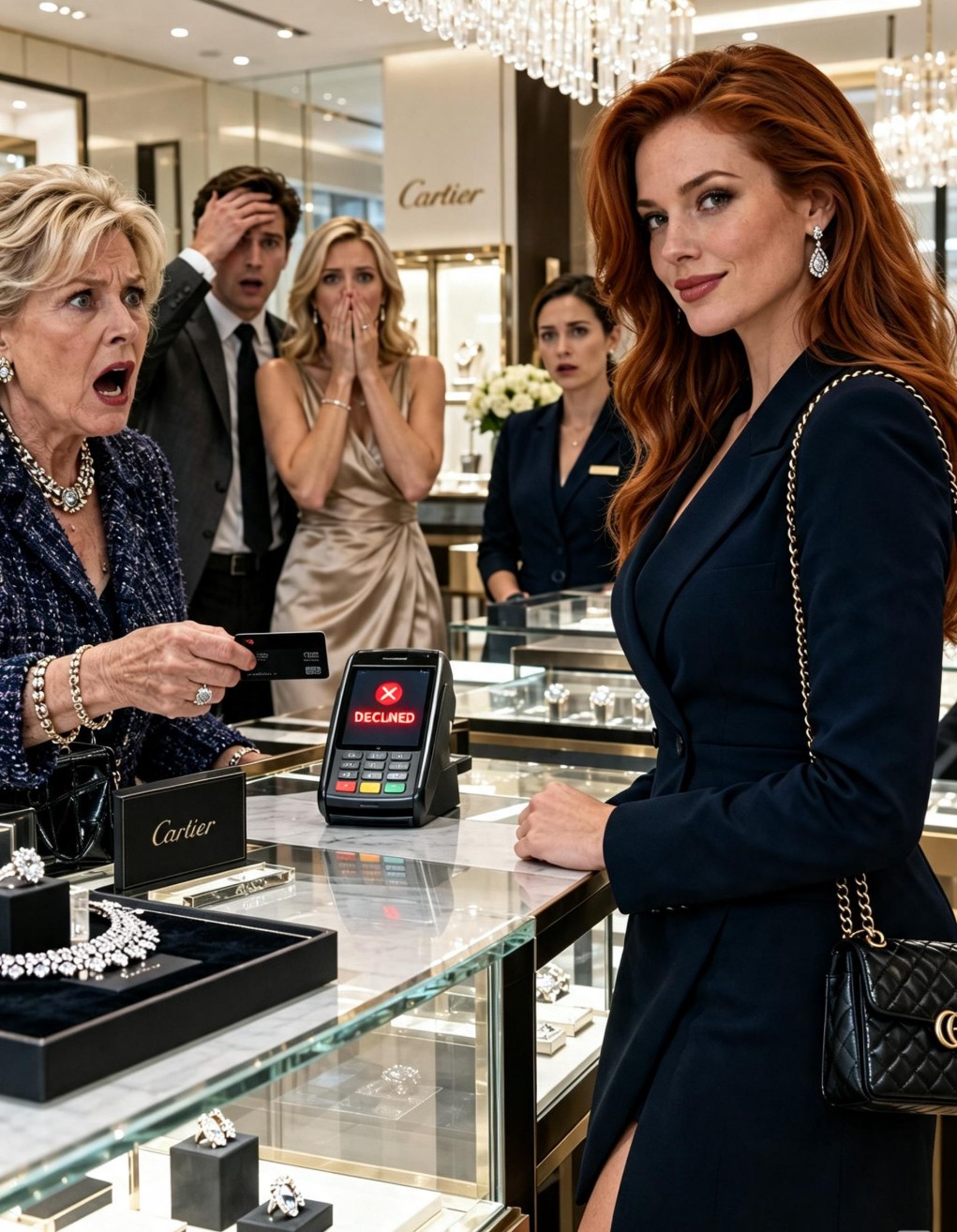
At 10:15, the escrow manager walked over carrying a payment terminal.
“Everything is ready, Mr. Lawson,” she said. “We just need the initial earnest money deposit of $300,000 to secure the property.”
Christopher nodded.
“Of course.”
He reached into his wallet and pulled out his heavy black metal card.
He handed it to her.
The manager inserted it into the terminal.
A sharp beep filled the room.
The screen flashed red.
TRANSACTION NOT AUTHORIZED.
The manager frowned.
She looked at Christopher.
“My apologies, sir. Sometimes these premium metal cards can be temperamental. Let me try the magnetic strip.”
She swiped the card.
Another beep.
The screen changed.
INVALID TENDER.
Beatrice immediately waved her hand.
“Your machine is obviously broken!” she declared. “Christopher, use your second black card.”
Christopher’s face tightened.
He pulled out another card.
His fingers were beginning to shake.
He inserted it.
The terminal beeped again.
TRANSACTION DECLINED.
The room became quiet.
Several other customers turned to look.
The sales agent’s smile disappeared.
“Sir,” he said carefully, “do you have a bank routing number we could use for a direct wire?”
Christopher swallowed.
He reached into his wallet again.
“Use this one,” he said. “This is the primary business account. It will definitely clear.”
The manager took the card.
She tapped it against the reader.
The terminal produced another error.
Then a security message appeared.
The manager’s expression changed.
“Mr. Lawson,” she said carefully, “the system says this card has been locked.”
Christopher leaned forward.
“What?”
“It says the primary account holder reported the card as unauthorized.”
Beatrice exploded.
“That is completely absurd!”
Her voice echoed across the marble floor.
“My son is the owner of a major technology company! Call your bank liaison immediately!”
The sales agent quickly called the priority support number for Standard Premier Trust.
He placed the phone on speaker.
A calm male voice answered.
“Standard Premier Trust Elite Services. This is Arthur speaking.”
The sales agent explained what had happened.
Arthur typed for several seconds.
The entire gallery fell silent.
Then he spoke.
“Ah. I see the issue.”
Christopher leaned closer.
“What issue?”
“The accounts ending in 4492 have been completely deactivated.”
Christopher’s face went pale.
“Deactivated? By whom?”
“I’m sorry for the confusion, sir,” Arthur replied. “But you were listed only as a supplementary user on those accounts.”
Christopher stared at the phone.
“I am the CEO of the company!”
Arthur remained calm.
“Yes, sir. But the primary account holder is Ms. Loretta Albright.”
Christopher stopped breathing for a second.
Arthur continued.
“She personally revoked all supplementary privileges three days ago. According to her instructions, you no longer have access to those financial accounts.”
The words seemed to freeze the entire room.
Beatrice slowly removed her designer sunglasses.
Her face had gone completely pale.
“Primary account holder?” she whispered.
She turned toward her son.
“Christopher… you don’t own these accounts?”
Christopher opened his mouth.
Nothing came out.
Melanie took a slow step backward.
Her expression had changed completely.
The excitement she had shown only minutes earlier was gone.
“Christopher,” she said quietly, “if Loretta’s name is on all the money, then what exactly do you have?”
Christopher had no answer.
Part 5:
The drive home from Grandview Estates was silent.
Beatrice sat in the passenger seat, staring through the window.
Her hands were tightly wrapped around her handbag.
For the first time in years, she was beginning to understand the truth.
The lifestyle she had proudly displayed to everyone had never been Christopher’s achievement.
Loretta had paid for it.
The expensive cars.
The vacations.
The furniture.
The bills.
The business.
Even the things Beatrice herself had enjoyed.
They had all been funded by the woman she had treated like she was not good enough for her son.
When Christopher finally walked through the front door, his phone began ringing.
He looked at the screen.
Auto finance company.
He answered.
“Mr. Lawson,” the caller said firmly, “this is an urgent notification. The payment on your mother’s luxury vehicle lease was returned this morning. If the outstanding amount is not received within forty-eight hours, repossession procedures will begin.”
Christopher closed his eyes.
“Understood.”
He ended the call.
His phone rang again.
This time, it was a jewelry finance company.
The payment on an expensive ring had not been made.
Then another call came in.
A debt collector.
The automated payments on his business office lease had stopped, and the account was already in default.
One call after another.
One problem after another.
Christopher sank onto the sofa.
He buried his face in his hands.
His entire life was collapsing because the person he had depended on was no longer there to rescue him.
Beatrice could not accept what she was seeing.
She walked into Christopher’s home office.
She opened drawers.
She searched through files.
She needed to know how badly things had been hidden from her.
At the bottom of a filing cabinet, beneath several old documents, she found a simple notebook.
She opened it.
The handwriting was immediately familiar.
It was mine.
Beatrice slowly began reading.
The pages contained years of financial records.
Thousands of dollars transferred into Christopher’s company.
Bills paid for his family.
Medical expenses covered.
Mortgage payments.
Office expenses.
Business debts.
One payment after another.
One sacrifice after another.
Then Beatrice found something else tucked inside the notebook.
An old letter.
It had been written by Christopher five years earlier.
She unfolded it.
The words made her hands tremble.
“Loretta,” the letter said, “I know you liquidated your personal savings to save my business today. I do not deserve you, but I swear that when I succeed, I will spend the rest of my life making this up to you.”
Beatrice read the letter again.
Then again.
Her hands began shaking.
She slowly sank onto the floor.
Tears ran down her face.
For the first time, she understood exactly how cruel she had been.
She had called Loretta a failure.
She had accused her of not giving Christopher a family.
She had bragged about Christopher’s success.
She had never bothered to ask who had made that success possible.
Now she knew.
It had been Loretta.
The kind daughter-in-law she had pushed away.
A short while later, Melanie came downstairs.
She was dressed in simple clothes.
Her luggage was packed.
Christopher looked up from the sofa.
“Melanie, please,” he begged. “Give me one month. I can restructure the business. I can get another loan.”
Melanie stopped near the doorway.
She looked at him with cold disappointment.
“This isn’t just about money, Christopher.”
He stared at her.
“It is about the size of the lie you told.”
She continued.
“You allowed that woman to sacrifice everything while you pretended to be a successful businessman.”
Christopher lowered his head.
Melanie shook hers.
“You are not the man I thought you were.”
She grabbed her suitcase.
Then she delivered the final blow.
“You are not a CEO, Christopher. You are a parasite.”
She walked out.
She did not turn around.
Christopher remained alone in the quiet house.
He pulled out his phone.
He tried calling Loretta.
Once.
Twice.
Again.
Every call failed.
He tried another number.
Blocked.
He opened social media.
Blocked.
He sent a message.
Blocked.
Every door he had once used to reach the woman who had spent seven years saving him was now closed.
And for the first time, Christopher had no one left to blame.
Part 6:
Two weeks later, my secretary called my office.
“Ms. Albright, Christopher Lawson is waiting in the main lobby.”
I stopped what I was doing.
“He says he only needs five minutes.”
I stared at the papers on my desk.
For a moment, I considered refusing.
Then I agreed.
I took the glass elevator downstairs.
Christopher was standing near the entrance.
I almost did not recognize him.
The expensive clothes were gone.
The confident posture was gone.
The arrogance was gone.
He was wearing an inexpensive, poorly fitted blazer.
He looked exhausted.
When he saw me, he lowered his eyes.
“Loretta.”
His voice was quiet.
“Thank you for coming down.”
We sat in a quiet corner of the lobby.
Christopher reached into his jacket and pulled out a plain manila envelope.
He placed it on the glass table between us.
“I sold my watch,” he said.
I looked at him.
“And my car.”
He swallowed.
“I also sold the equipment that was left at the office.”
He pushed the envelope toward me.
“There is a cashier’s check inside for $80,000.”
I did not touch it.
“I know it doesn’t come close to covering what I took from you,” he continued. “But I need you to have it.”
I looked at the envelope.
“The divorce is finished, Christopher. Legally, you do not owe me anything.”
His eyes filled with tears.
“Morally, I owe you everything.”
He looked down at his hands.
“I thought you would always be there.”
His voice cracked.
“I was so blinded by my own ego that I forgot you were the person keeping everything alive.”
A tear rolled down his cheek.
“I am so deeply sorry.”
I watched him quietly.
Then I shook my head.
“Christopher, I did not leave because of the money.”
He looked up.
“I left because a marriage cannot survive when one person is building a life while the other person simply drains it.”
I pushed the envelope back toward him.
“Keep the money.”
He stared at me.
“Use it to help your mother with her expenses.”
His face tightened.
“If I could go back,” he whispered, “if I could change everything… would you still have stayed with me?”
For a moment, I remembered the man I had met nine years earlier.
The ambitious man with empty pockets and huge dreams.
The man who had held my hands and promised to build something great.
“I would have loved the ambitious man I met years ago,” I said softly.
Christopher looked down.
“But I will never set myself on fire again just to keep someone else warm.”
I stood.
“Goodbye, Christopher.”
I walked toward the elevators.
I did not look back.
This time, I was not walking away because I was angry.
I was walking away because I had finally chosen myself.
A few days later, I agreed to meet Beatrice for tea at a quiet café near the park.
She looked completely different.
The confidence was gone.
The pride was gone.
She looked fragile and humbled.
As soon as I sat down, she reached across the table and touched my hand.
Her fingers were trembling.
“Loretta, I am so sorry,” she said through tears.
I remained quiet.
“I was blind,” she continued. “I was arrogant. I believed everything Christopher told me.”
She wiped her eyes.
“And now we have lost everything.”
I gently pulled my hand back.
“Beatrice, some things cannot be repaired once they are broken.”
She lowered her head.
“But I do not hate you,” I added.
She looked at me through tear-filled eyes.
Before leaving, I placed a small bag on the table.
She opened it.
Inside was a prepaid year’s supply of her daily health supplements.
She stared at me in surprise.
“You still thought of me?” she whispered.
I gave her a small smile.
“Take care of yourself.”
Then I stood and walked out into the afternoon air.
That was the last time I saw her.
A year later, my corporation held a large gala at a downtown hotel to celebrate an extremely successful fiscal year.
I stood on stage wearing an elegant navy gown.
The room was filled with executives, investors, employees, and business leaders.
Then my name was announced.
I had been chosen as Executive of the Year.
The room erupted in applause.
I accepted the award and looked across the crowd.
For years, I had measured my success through numbers.
Revenue.
Profit.
Growth.
Investments.
Balance sheets.
But standing there, holding that award, I understood that my greatest achievement had nothing to do with money.
I had survived.
I had walked away.
I had rebuilt my life.
And I had done it without becoming bitter.
The following morning, I stood on the balcony of my penthouse with a cup of warm tea in my hands.
Fresh winter snow covered the city below.
The buildings looked quiet and peaceful beneath the white blanket.
I thought about Christopher.
I thought about Beatrice.
I thought about the woman I had been seven years earlier.
She had believed love meant carrying someone else’s weight forever.
She had believed loyalty meant forgiving everything.
She had believed that if she worked hard enough, sacrificed enough, and loved enough, the other person would eventually appreciate it.
Now I knew better.
My greatest victory was not the moment I locked Christopher’s bank cards.
It was not the day I signed the divorce papers.
It was not even the moment I watched his carefully constructed world collapse.
My greatest victory was the moment I finally understood my own worth.
I had spent years discounting myself for people who did not appreciate what I gave them.
I would never do that again.
I took another sip of tea.
Then I turned away from the cold balcony and walked back inside.
The future was waiting for me.
And for the first time in years, it belonged entirely to me.
THE END.
