
My friend Mike never shows emotions. He’s the kind of guy who calls feelings “system noise.”
So when he told me about the man and the cat in the snow, I knew it wasn’t just another random story. This was something special, something that sticks in your chest and weighs you down in a quiet, heavy way.
A few weeks ago, Mike, who’s 34, sat me down and started talking. Mike isn’t sentimental at all. He builds his own computers for fun, alphabetizes his spice rack, and once described grief as “emotional latency.”
The closest he’s come to drama was when his router died during a D&D campaign. So, when he said he couldn’t stop thinking about a man outside a grocery store, I knew it was serious.
“I saw him every day. Same spot, same time. Right in front of the Kroger on 14th,” Mike said, sipping his Coke like it was nothing.
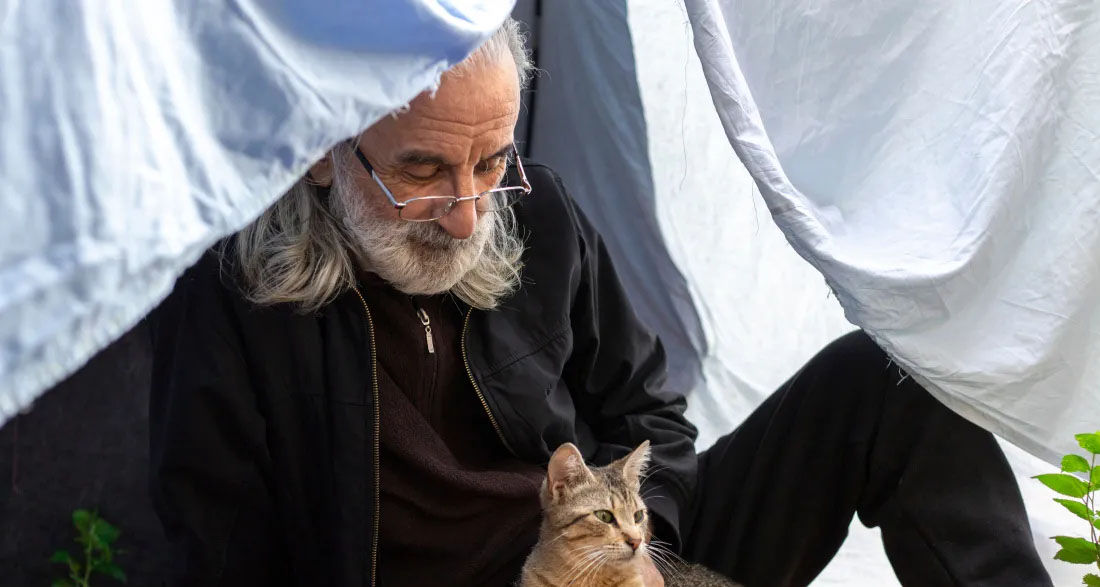
The man’s name was David. He was probably in his mid to late 50s, maybe older — you couldn’t really tell through the long beard and the weathered face. His face looked like it had forgotten how to be young.
His clothes were layered but barely protected him from the wind, and his hands looked like cracked leather. But Mike didn’t focus on any of that. What grabbed his attention was the cat.
A tiny black cat with eyes like halogen lights, tucked into David’s chest like a secret. Every single night, she was there.
David would zip his old jacket halfway and let her nestle inside, like a heartbeat. Mike said it wasn’t cute, not like a pet sleeping on a lap.
It was something deeper, intimate, like they had survived something brutal together. It was their silent promise: I’ve got you.
“People would walk around them like they were invisible,” Mike said. “Like he was just part of the scenery. Garbage and gum wrappers and frostbite.”
Then came the night of the snow. Thick, wet chunks, the kind that soak through everything in minutes.
Mike was heading into Kroger to grab frozen pizzas when he noticed David holding a flimsy paper cup. No one was dropping coins. No one was stopping. The cat, for the first time, was shivering.
“I walked past,” Mike admitted. “Didn’t even think about it. But then… god, I don’t know… I turned around. Bought a coffee.”
He walked up to David and asked, “Hey. Does she have a name?”
David looked up slowly. His voice cracked as he said, “Mara. My kids named her. Long time ago.”
That one line hit Mike like a hammer. It broke something open inside him. And that’s where everything started.
Mike didn’t plan to get involved. “I just wanted to warm him up for one night,” he said. “Not become part of the guy’s life.” But life doesn’t ask permission before handing you someone else’s pain.
After that night, Mike started showing up on purpose. A sandwich. Hot coffee. Gloves. Once, a can of tuna just for Mara. David would always whisper thank you, careful, like gratitude might spill out too much.
“You don’t have to do this,” David told him once, his breath fogging in the cold air.
“I know,” Mike said. “But I want to.”
Over time, David started talking. Not in big bursts, not dramatic speeches — but in pieces, like puzzle pieces scattered on the pavement. Mike would sit beside him, pass him coffee, and wait. And David would talk.
He used to have a life. Maintenance work in a small apartment complex on the west side. He knew every leaky faucet, every busted AC.
His first marriage ended, but they had two kids — Eli and Rose. One day, the kids found a half-drowned kitten under a porch during a storm.
“She was so small,” David said, staring at Mara in his lap. “Fit in my boot. Rose named her Mara after some cartoon fairy. We fed her with a dropper for a week.”
But then life spiraled.
He lost his job at 54. Layoffs. No severance. His second wife — “the loud one” — lost patience fast. “Useless,” she’d hiss when he couldn’t make rent.
He started drinking. “Not to forget,” he admitted. “Just to… turn the volume down.”
Then came the day everything cracked.
“I came home and the door chain was on,” David said, eyes glassy. “Clothes in trash bags. Mara in this cheap plastic carrier with a broken latch. She was meowing. I knew what that meant.”
Mike leaned forward. “What did she say?”
“She said, ‘I can’t do this anymore. The kids don’t want to see you. Just go.’”
“And the kids?”
“Standing behind her. Didn’t move. Didn’t say a word. Just… watched.”
The door closed. Just like that.
The descent was slow. You don’t fall into homelessness — you slide. Shelters turned him away because of Mara. “No pets,” they said. So he chose the street.
“I lost my home, my job, my kids,” David said one night. “I’m not losing her too.”
He once gave his gloves to someone else because Mara was shivering. “I deserve this,” he told Mike. “I messed up. But she didn’t.”
That line — Mike said it — was the first time he almost cried in front of someone else.
Then came the night everything changed. The cold wasn’t just winter cold. It was dangerous, bone-deep, the kind that doesn’t give your body back.
Mike had finished a late shift and decided to swing by the store — not for groceries, just a gut feeling. “I don’t know why,” he said later. “Just awful static under my skin.”
He turned the corner and froze.
David was slumped against the wall, but this time… something was wrong. He looked heavy, unnatural, like his body had given up.
Eyes half-open, lips blue, skin waxy. Mara, usually calm, was outside his jacket, yowling, batting at his face desperately.
“David!” Mike dropped to his knees. “David, hey! Can you hear me?”
No response. Just a soft exhale, like the last flicker of a match.
Mike’s hands shook as he dialed 911. “He’s not moving. I think hypothermic shock… yes, there’s a cat. She won’t leave his side.”
When the ambulance arrived, a paramedic said, “We can’t take that cat in the vehicle.”
“The hell you can’t,” Mike snapped. “She’s emotional support. He’ll panic if you take her.”
After a tense pause, they gave in. Mara was gently placed in a cardboard produce box Mike grabbed from recycling, right next to David in the ambulance.
At the hospital, a nurse with tired eyes looked Mike straight in the face.
“If he stayed out there another hour,” she said flatly, “he probably wouldn’t have made it.”
Mike took Mara home that night. She didn’t hide, didn’t hiss. She curled up on his pillow and slept like she’d been holding her breath for days.
While she slept, Mike dug for solutions. Pet-friendly shelters. City outreach.
Most said no. But one small pilot program said yes: supportive housing, tiny rooms, heat, pets allowed, strict rules, mandatory counseling, but a real place to start.
The next day, Mike visited David in the hospital. He was awake but barely. Eyes sunken, lips cracked.
“Where’s Mara?” he rasped.
Mike smiled, setting the box on David’s lap. Mara popped her head out, nuzzling his trembling fingers.
“I found a room,” Mike said. “Warm, safe. They’ll take both of you. But you have to go. You have to try.”
David looked away, tears slipping down. “I don’t deserve that.”
“Maybe not,” Mike said softly. “But she does. Don’t make her pay for your guilt.”
David finally nodded.
Months later, Mike visited. The building was ordinary — worn brick, humming pipes, faint smell of instant noodles. But inside room 203, things were different.
David sat by the window, a small heater humming beside him. The room was modest: twin bed, table, chipped dresser. Clean. Lived-in.
On the wall, a cheap plastic frame held a photo: David, younger, standing beside two laughing kids and a tiny black kitten.
Mara sprawled on the bed like she owned it — and Mike joked, maybe she did.
“She lets me use the bed as long as I pay her in tuna,” David said, grinning. A spark in his eyes that hadn’t been there before.
“I’ve been doing odd jobs,” he added. “Cleaning, fixing stuff. Haven’t had a drink in… 61 days.”
“That’s incredible,” Mike said.
David nodded. “Yeah. I guess it is.” Then he pulled a folded piece of paper from his pocket. “I wrote my kids. Told them I’m here. Not asking for anything. Just trying.”
“My daughter wrote back,” David said, voice catching. “Not ready to see me yet. But… she said thank you. For keeping Mara safe. Said she never stopped loving her. And she’s trying to figure out how she feels about me.”
Mike swallowed hard.
“You know,” David said, eyes misty, “for the first time in years… I don’t feel like trash someone left on the sidewalk.”
Mike smiled. “You never were.”
