
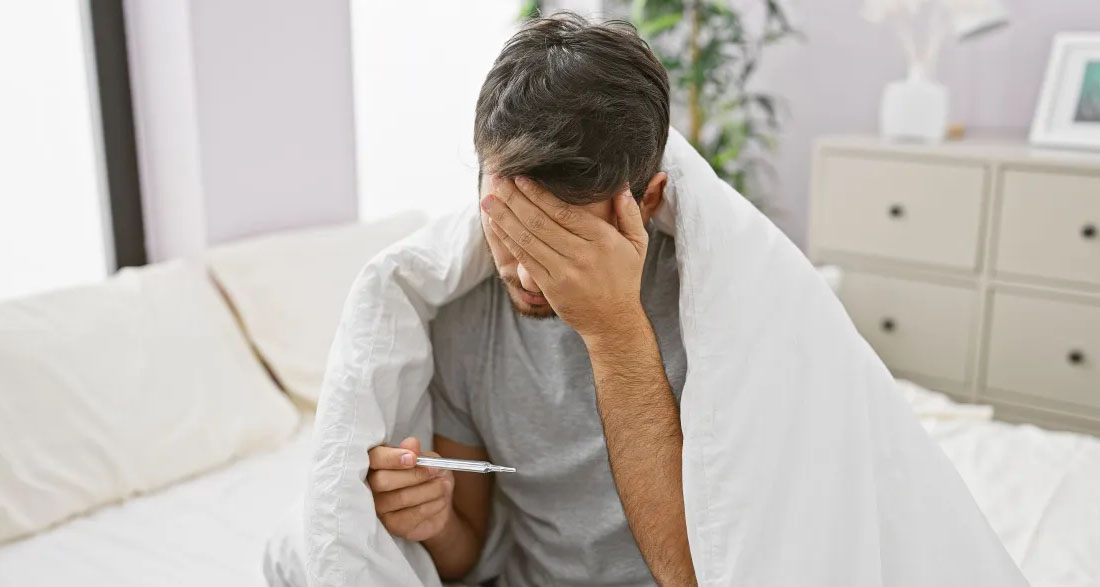
When Derek came home from his work trip, he looked like someone who had survived a war.
You know that scene in a disaster movie when the hero crawls out of rubble, exhausted, battered, barely holding it together? That was him.
He stood in the doorway, suitcase dragging at his side like an anchor tied to his leg. His eyes were glassy, skin pale, and a thin sheen of sweat clung to his forehead.
I stepped forward to take the bag, but he didn’t let go. He just dropped it, like lifting it again might knock him off balance.
“I feel awful, Leigh,” he muttered, voice hoarse. “I barely slept. I’ve been running on fumes since before the conference.”
I nodded, guilt prickling at me. Sure, I’d been up every two hours for five nights straight with our colicky twins who cried in shifts, but he’d been “out there,” working.
Long hours, stressful clients, hotel rooms. That’s what I told myself.
He shuffled toward the stairs, but I stepped in his way.
“No, honey,” I said firmly. “Guest room. You’re not going near the twins until we figure out what this is.”
He didn’t argue. He just kept walking, like any detour from the stairs was a kindness I was offering.
By morning, a rash had bloomed across his torso—angry, red bumps forming tight clusters on his shoulders, arms, and neck. My stomach sank.
I pressed the thermometer to his forehead and felt a sharp twist of fear.
“Derek,” I said, gently pulling down the collar of his shirt. “This looks like chickenpox, honey. Your rash matches almost every photo I’ve seen online.”
He blinked at me like I’d accused him of murder.
“No,” he croaked. “It’s probably stress. My immune system’s just trash. That conference destroyed me.”
I went into survival mode. I brought him food on a tray like I was serving royalty. Soup, exactly the way his mother used to make it—chicken, carrots, not too salty.
He didn’t even notice the effort. I ran cool washcloths over his forehead while he groaned like a man surviving some epic ordeal.
And all the while, I kept our babies away from him, washing everything twice, bathing them in lavender water, keeping the baby monitor with me constantly.
“You don’t have to fuss so much, Leigh,” he said once when I came in with another load of clean sheets.
“I do,” I replied. “The twins are not vaccinated.”
“Then take them to get vaccinated, Leigh,” he said, frowning.
“They can’t. Not until they’re a year old. Have you read any parenting books?”
He didn’t answer, just shifted in bed like the topic was too heavy for him.
Even as I cared for him, he fed me stories about his awful clients, the long nights preparing slides, the pressure he felt. I tried not to think about how far away he had seemed even before this trip.
We were supposed to have dinner that weekend with my mom, Kevin, and Kelsey—my stepdad and stepsister. Kevin was kind and steady, Kelsey… difficult. I almost canceled. Then my stepdad texted:
“Hey kiddo, sorry, but we need to reschedule. Kelsey’s sick. Looks like chickenpox. Mom and I were looking forward to seeing the twins. Soon, okay?”
Then he sent a photo.
I opened it and froze. Kelsey, wrapped in a blanket on Mom’s couch, her face dotted with red blisters—the exact same pattern Derek had.
Same placement. Same pattern. Same week.
Kelsey’s “girl’s trip.” Derek’s “work trip.”
I stared at the photo until the screen dimmed, tapped it again, hoping it would change, hoping I had read it wrong. My instincts told me I hadn’t.
“Everything okay?” Derek’s voice floated up from downstairs.
“Yeah,” I said, swallowing the lump in my throat. “Just changing the twins. I’ll be down in a minute.”
The lie tasted sour in my mouth. Chickenpox is contagious. Could it be a coincidence? Maybe. But timing, his shifting eyes, Kelsey’s silence—they all screamed otherwise.
That night, while Derek slept under a film of sweat, I sat on the nursery floor, one twin curled on my shoulder, the other in the crib.
The room smelled of baby lotion and fabric softener, warm and soft—things that didn’t deserve the shadow creeping in. I didn’t want to check his phone. But I couldn’t ignore the truth either.
Once the twins were in deep sleep, I went into the guest room, lifted Derek’s phone, and sat in the laundry room with the door closed.
Hidden albums.
The first image nearly sent the phone flying: Derek in a white robe, champagne glass in hand, grinning.
Next: Kelsey, identical robe, hand resting on his chest.
Then: his mouth on her neck.
I stared until I couldn’t breathe. Betrayal wasn’t a word anymore. It was an infection—literal and figurative—brought into our home under the mask of stress. He let me tend him, protect our babies, while secretly exposing us to danger.
I should have packed the twins and left. I should have been braver.
Still, I didn’t confront him. The next morning, I handed him tea, smiled like nothing had happened.
“How are you feeling?” I asked, opening the windows.
“Better,” he said. “So much better, Leigh. I think I’m healing.”
“That’s good, babe,” I said.
I texted my stepdad:
“Let’s do dinner this weekend. I’ll host. I need grown-up conversation, not lullabies.”
“Yes! We’re in. Kelsey’s perfectly fine and back on her feet. Mom and I can’t wait to see the babies. We bought the cutest onesies.”
Saturday arrived. The house smelled of roast chicken and thyme. I baked rolls, pumpkin pie, and set the table like nothing had broken.
Kelsey was first to arrive, foundation too thick, laugh too high. Derek’s eyes barely met hers. I noticed the flicker.
Mom pulled me aside.
“You sure you’re up for this, Leigh? You look so tired.”
“I am tired, Mom,” I admitted. “But I wanted tonight to feel normal. Just for a little while.”
“You’re a good mom, Leigh,” she said, hand on my arm. “More than most could, especially with an ill husband to care for.”
Dinner passed in careful rhythm—diapers, cold remedies, overpriced baby items. Kelsey laughed too loudly. Derek sipped wine silently. Mom’s gaze kept flicking between them.
“Is Derek okay?” she asked.
“He’s still recovering, Mom,” I said.
When dessert was cleared, I stood, glass in hand.
“I want to say something,” I said.
“To family,” Mom jumped in quickly.
“Yes,” I said. “And to the truth.”
The air shifted.
“These past few days taught me how fast a virus can disrupt a home. Especially when your babies aren’t vaccinated. Especially when it’s brought in by someone you trust.”
My stepdad frowned. “This about Derek being sick?”
“My husband came back from his work trip with chickenpox,” I said, turning to Derek. “And my stepsister came back from her girls’ trip with the exact same thing.”
Kelsey froze.
“So, someone please help me understand how two people on two different trips caught the same illness at the same time, unless those trips weren’t so separate after all.”
“Leigh, not here,” Derek said, exhaling sharply.
I slid his phone across the table to my parents. The images I had saved earlier glared at them from the screen. Mom’s mouth opened slightly. Kevin’s jaw clenched.
“You cheated,” I said, voice steady. “You risked our children and lied while I took care of you.”
Kelsey cried. “It wasn’t supposed to happen, Leigh.”
“I can’t believe this,” Mom said. “I think you need to leave, Kelsey.”
“Yes, you should go,” I said, voice cold. “But let me know where to send the divorce papers.”
“If you ever come near Leigh or those babies again, you’ll answer to me,” Kevin added, voice booming.
Derek froze. No one defended him.
He left.
The silence that followed felt like my first breath of fresh air in weeks. I deep-cleaned the house, finally brought the twins into the living room. Even they seemed calmer.
Derek flooded my phone with texts, begging, blaming stress and the babies. One reply from me ended it:
“You risked our children’s lives, Derek. Everything you’ve done is unforgivable. Do not contact me unless through a lawyer.”
Sometimes, the thing that almost destroys you—the lie, the affair, the virus—is the thing that finally sets you free. Derek brought a virus into our home, but I was the one who had to heal.
And that’s what I want you to understand.
