
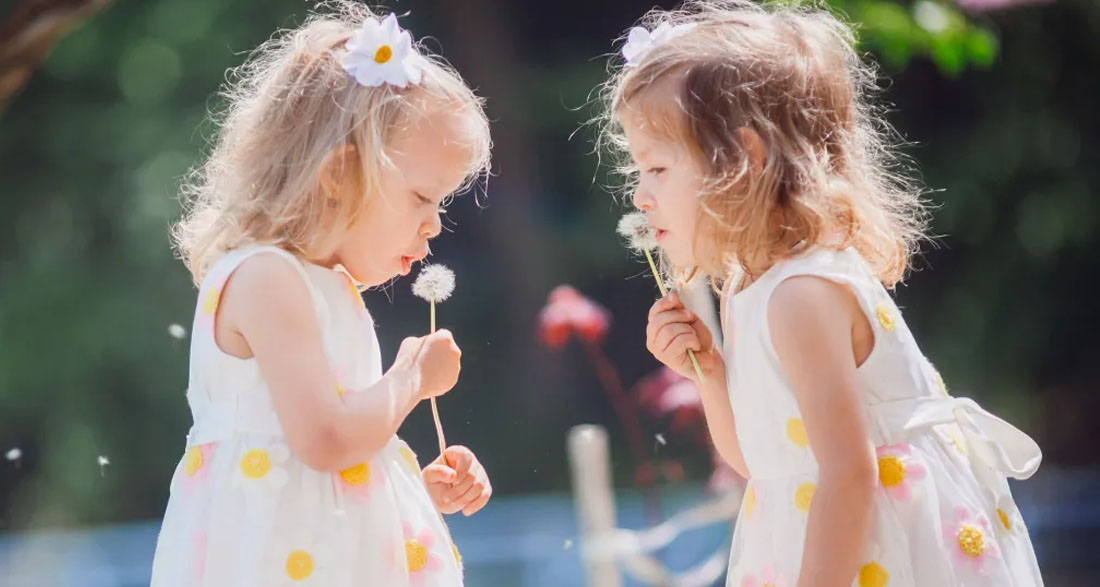
When a boy pointed at my twins’ grave and said, “Mom… those girls are in my class!” I froze.
At first, I thought my grief was playing another cruel trick, twisting reality in ways I couldn’t bear. But it wasn’t my imagination this time.
That moment pulled old secrets from the shadows and forced me to confront the truth about the night my daughters died—and the heavy blame I had carried alone for two years.
If you’d told me two years ago that I’d end up talking to strangers in cemeteries, I would have laughed, maybe even slammed the door in disbelief.
Now, laughter had left me.
I counted my steps toward their grave, trying to measure each one like it could bring me closer to peace. Thirty-four… thirty-five… thirty-six. That’s when I heard it, clear as the wind cutting through the cemetery:
“Mom… those girls are in my class!”
I couldn’t move. My hands still clutched the lilies I’d bought that morning—white for Ava, pink for Mia. I hadn’t even reached their headstone.
The wind in March was sharp, biting through my coat and carrying memories I’d worked for a year to suppress. I glanced back, half expecting to see a trick of my mind.
But there he was. A little boy, red-cheeked, eyes wide, pointing straight at the place where my daughters’ smiling faces looked up from cold stone.
“Eli, come say ‘Hi’ to your dad,” a woman’s voice called, trying to hush him.
I couldn’t move. My grief anchored me to the ground.
Ava and Mia were five when they died.
I remember the house that night, alive with laughter. Ava dared Mia to balance on a couch cushion. “Watch me! I can do it better!” Mia shouted, giggling. Their joy bounced off the walls like music, and I stood in the doorway, warning them but smiling anyway.
“Careful,” I said. “Your father will blame me if someone falls.”
Ava grinned. Mia stuck out her tongue.
“Macy will be here soon, babies. Try not to give her a headache while we’re out,” I added.
That was the last ordinary moment I had with them.
The next memory comes in shards. A phone ringing. Sirens wailing nearby. My husband Stuart calling my name over and over as someone guided us down a hospital hallway.
I bit my tongue so hard I tasted blood, holding myself together, desperate not to scream.
I don’t remember the priest’s words at the funeral. I only remember Stuart leaving our bedroom that first night, the door clicking softly behind him—a sound louder than anything else in the world.
I bit my tongue.
Now, at their grave, I knelt and pushed the lilies into the grass beneath their photograph.
“Hi, babies,” I whispered, fingers brushing the cold stone. “I brought the flowers you like.”
My voice was smaller than I expected, fragile against the wind.
“I know it’s been a while,” I continued. “I’m trying to be better about visiting.”
Then I heard it again.
“Mom! Those girls are in my class!”
I turned slowly. This wasn’t coincidence.
The boy—Eli, I later learned—was six or seven, holding his mother’s hand, pointing at the photograph.
His mother quickly lowered his arm. “Eli, honey, don’t point,” she said, giving me a hesitant, apologetic smile.
“I’m sorry,” she whispered. “He must be mistaken.”
But my heart had started racing.
“Please… can I ask what he meant?” I said, my voice shaking.
She crouched to meet his eyes. “Eli, why did you say that?”
He didn’t look away. “Because Demi brought them. They’re on our wall at school, right by the door. She said they’re her sisters and they live in the clouds now.”
Demi. That name hit me like a thunderclap.
“Demi’s your friend at school, sweetheart?” I asked, holding my breath.
He nodded. “She’s nice. She says she misses them.”
His mother softened. “The class did a project about who’s in your heart. Demi brought a photo of her sisters. I remember how upset she was when I fetched Eli. But maybe they just look alike…”
“She says she misses them,” Eli repeated.
Sisters. My stomach twisted. I glanced at the headstone, then back at Eli.
“Thank you for telling me, sweetheart,” I managed. “Which school are you in?”
They left, the mother glancing back, worried maybe he had said too much. I stood there, arms wrapped around myself, the ache of memory sharpening into something electric.
Demi. The name I had known, the one everyone who knew what happened remembered.
“Thank you for telling me,” I whispered again.
Back at home, I paced the kitchen, touching surfaces as if the world would vanish if I didn’t keep moving.
Macy. The babysitter. Demi’s mother.
The pieces clicked. Why would Macy keep a photo from that night? Why give it to Demi for a school project?
I stared at my phone, thumb hovering, unsure what to say. Finally, I called.
“Lincoln Elementary, this is Linda,” a receptionist answered.
“Hi, my name is Taylor. I’m sorry to bother you, but… I think my daughter’s photo is up in a first-grade classroom. They… Ava and Mia… passed away two years ago. I just…” My voice faltered. “I need to understand how it’s being used.”
A long pause. “Oh. Oh my goodness. I’m so sorry, hon. Would you like to speak with Ms. Edwards, the class teacher?”
“Yes, please. Thank you.”
Muffled shuffling, then another line clicked on. “Taylor? I’m Ms. Edwards. I’m so sorry for your loss. Would you like to come in and see the photo yourself?”
“Yes. I think I need to.”
At the school, Ms. Edwards met me in the office, her hands gentle on my arm. “Would you like some tea?”
I shook my head, barely seeing the bright hallway plastered with kids’ artwork. “Can we… just go to the classroom?”
She nodded. The classroom buzzed softly with the sounds of crayons and whispering. On the memory board, between pet photos and smiling grandparents, was the photograph:
Ava and Mia in pajamas, faces sticky with ice cream, Demi in the middle holding Mia’s wrist.
“Where did this come from?” I asked, stepping closer.
Ms. Edwards kept her voice low. “I don’t know how much I can tell you. Demi said those were her sisters. Her mother, Macy, brought the photo. She said it was from their last ice cream trip.”
I pressed my palm to the wall for support. “Macy gave it to you?”
“Yes. She said the loss was really difficult on Demi. I didn’t ask questions—how could I?”
I nodded, throat tight. “Thank you. Really. I want Demi to keep her memory.”
At home, I found the courage to call Macy. The phone rang four times before she answered, voice thin and wary.
“Taylor?”
“I need to talk.”
A pause. “All right.”
Her house was smaller than I remembered, the garden littered with Demi’s toys. She met me at the door, hands shaking.
“Let Demi keep her memory,” I said.
“Taylor, I’m so sorry. Demi misses them… I kept meaning to reach out —”
I cut her off. “Why did you still have a photo from that night? I recognized the girls’ pajamas.”
Her jaw tightened. Shame flickered across her face.
I forced the question: “That photo—was it taken that night? I just need to hear you say it.”
Macy’s shoulders slumped. “Yes. I… I haven’t told you everything.”
“Then tell me now. All of it.”
Her hands twisted together. “That night, I was supposed to pick Demi up from my mother’s house. The twins were in the car with me.”
I remembered that night, how they’d helped me choose my gala dress.
“They started begging for ice cream,” Macy said. “I just wanted to make them happy. It was only ten minutes… what’s the harm?”
“But you told the police there was an emergency with Demi?”
Macy’s face crumpled. “I lied. There was no emergency. I wanted to include Demi. I’m so sorry, Taylor.”
Silence fell, heavy and suffocating.
“Did Stuart know? Did you tell him?” I asked.
She nodded, tears slipping down. “After the funeral. He was furious… told me not to tell you. Said it would break you. The truth wouldn’t change anything. Demi was upfront with me. We walked away with scratches.”
Her voice broke. “The twins didn’t.”
“So… you let me believe I was a bad mother for leaving my daughters at home. All this time?”
Macy sobbed. I listened a second longer, then turned and walked out. The door clicked softly behind me.
He was furious with me.
That night, the house felt emptier than ever. I made tea I didn’t drink and stared out the window at blurred streetlights.
I remembered every time I tried to ask Stuart about that night.
“Did Macy tell the police everything? Are you sure?”
His answer: “It won’t bring them back. Let it go.”
Not now. Not after knowing he let me bear the weight alone.
I texted him:
“It won’t bring them back. Meet me at your mother’s fundraiser tomorrow. Please. It’s important.”
No reply.
The hotel ballroom was bright, full of chatter. Waiters weaved through trays of drinks. Stuart stood at the edge, surrounded by polite condolences.
I walked up. Every step felt like a test.
He saw me, surprise flickering. “Taylor, what—”
“We need to talk.”
He shifted. “Not here. This isn’t the place.”
“No, Stuart. This is exactly the place.” My voice carried farther than I meant. Heads turned.
Macy appeared beside us, eyes red. His mother’s favorite.
“For two years, you let people look at me like I was the reason our daughters died, like wanting one night out made me a bad mother,” I said. Hands shaking, eyes locked on him. “You brought Macy into our lives! You said she was a good babysitter!”
His face went pale. “Taylor, please.”
“You let Macy hide what she did!” My voice rose. “You let me carry all that blame. You knew the truth would free me. Tell everyone! Tell them Macy took the girls out for fun, not for an emergency.”
“Taylor, please,” he whispered, defeated.
“It changes everything,” I said.
Stuart’s mother stared at him as if she didn’t recognize him. Around us, the room went quiet. No one defended him. A woman near the bar lowered her glass in open disgust. Another stepped back. Macy just cried.
I turned to her. “You made a reckless choice. Then you lied. I know you loved them. But love doesn’t erase what you did.”
For the first time since the funeral, I breathed freely.
No one looked at me with pity anymore.
A week later, I knelt at their grave, tulips pressed into the earth.
“I’m still here, girls,” I whispered. “I loved you. I trusted the wrong people. But none of this was my shame to carry.”
I brushed my fingers over their names. “I carried the blame long enough. I’m leaving it here now.”
I stood, finally free, the weight lifted.
“I’m still here, girls.”
